Choosing the right audio interface can greatly impact your music production journey. With so many options available, you might feel overwhelmed. However, understanding what suits your needs can lead to better recordings and a smoother workflow. From the Focusrite Scarlett Solo 4th Gen to the M-AUDIO M-Track Duo, each interface offers unique features. Let’s explore these top picks and see which one might be the perfect fit for your creative endeavors.
Focusrite Scarlett Solo 4th Gen USB Audio Interface

The Focusrite Scarlett Solo 4th Gen USB Audio Interface is perfect for beginner musicians, especially guitarists and vocalists, who want studio-quality recordings without a complicated setup. With a dynamic range of 120dB, you’ll experience professional sound quality that rivals major studios. The enhanced Air mode adds a rich harmonic drive, elevating your vocals and guitar recordings. Plus, it comes bundled with essential software like Pro Tools Intro+, Ableton Live Lite, and FL Studio Producer Edition, giving you everything you need to record, mix, and master your music. It’s designed for ease of use, so you can focus on creativity, not technicalities.
Best For: Beginner musicians, particularly guitarists and vocalists, seeking studio-quality recordings with an easy setup.
Pros:
- High-fidelity audio quality with a dynamic range of 120dB, ensuring professional sound.
- Enhanced Air mode for rich harmonic drive, improving the quality of vocals and guitar recordings.
- Comes with a comprehensive software bundle that includes Pro Tools Intro+, Ableton Live Lite, and FL Studio Producer Edition.
Cons:
- Limited to one microphone and one instrument input, which may not suit more complex recording setups.
- Some users may find the software bundle overwhelming if they’re new to music production.
- The interface may lack advanced features found in higher-end models, which could limit growth for more experienced users.
Focusrite Scarlett Solo 3rd Gen USB Audio Interface

Ideal for singer-songwriters and podcasters, the Focusrite Scarlett Solo 3rd Gen USB Audio Interface delivers studio-quality sound in a compact design. It features high-performance mic preamps and a switchable Air mode for enhanced clarity, recording at up to 24-bit/192kHz. You’ll appreciate the Gain Halo metering, which prevents clipping and guarantees pristine audio quality. Connecting directly to your Mac or PC via USB-C, it requires no external power and is compatible with various devices. Plus, you get access to software like Pro Tools Intro+ and Ableton Live Lite, making it an excellent tool to kickstart your music production journey.
Best For: The Focusrite Scarlett Solo 3rd Gen USB Audio Interface is best for singer-songwriters, podcasters, and producers seeking a compact and high-quality recording solution.
Pros:
- High-performance mic preamps with switchable Air mode for enhanced audio clarity.
- Records at up to 24-bit/192kHz, ensuring studio-quality sound.
- Bundled with industry-standard software like Pro Tools Intro+ and Ableton Live Lite.
Cons:
- Limited to two inputs, which may not be sufficient for larger setups.
- The compact size may be less ergonomic for extended use.
- Lacks built-in effects processing, requiring reliance on software for sound manipulation.
M-AUDIO M-Track Duo USB Audio Interface for Recording and Streaming
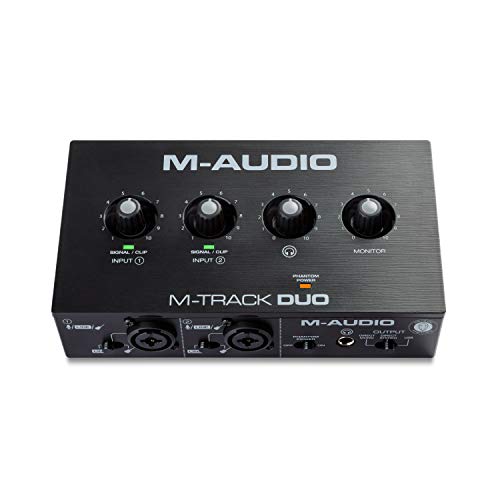
For those just starting in music production or streaming, the M-AUDIO M-Track Duo USB Audio Interface stands out with its dual XLR inputs and versatile functionality. This compact interface offers 48 kHz audio resolution, ensuring your recordings maintain high quality. With transparent Crystal Preamps, you’ll get the best sound from any microphone, including condenser mics. The two combo XLR/Line/Instrument inputs come with phantom power, allowing you to effortlessly record vocals or instruments. Plus, its 1/4” headphone output and USB/Direct switch provide zero latency monitoring, making real-time audio feedback a breeze. Don’t forget, it also includes MPC Beats Software to enhance your production!
Best For: Beginners in music production, streaming, and podcasting looking for a versatile and high-quality audio interface.
Pros:
- High audio resolution of 48 kHz ensures professional sound quality.
- Versatile input options with dual XLR/Line/Instrument inputs and phantom power for various recording needs.
- Zero latency monitoring capability for real-time audio feedback during recordings.
Cons:
- Limited number of inputs may not suffice for larger setups.
- Lacks advanced features found in more expensive interfaces.
- May require additional software knowledge for optimal use.
M-AUDIO M-Track Solo USB Audio Interface for Recording and Podcasting
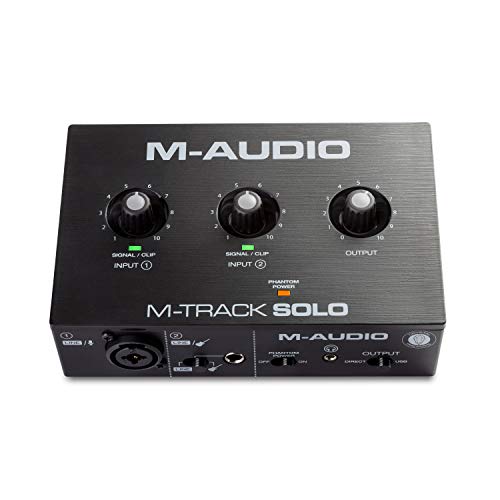
Designed with aspiring musicians and podcasters in mind, the M-AUDIO M-Track Solo USB Audio Interface offers an accessible entry point into high-quality recording. Supporting both Mac and PC, it delivers 48 kHz audio resolution for clear sound. You’ll find one combo XLR/Line input with phantom power and an additional Line/Instrument input, perfect for capturing vocals and instruments. The 1/8” headphone output and stereo RCA outputs allow flexible monitoring, while the USB/Direct switch guarantees zero latency for real-time feedback. Plus, the included MPC Beats Software equips you with essential tools to elevate your music production experience.
Best For: Aspiring musicians and podcasters seeking an affordable and high-quality audio interface for recording and streaming.
Pros:
- High-quality 48 kHz audio resolution ensures clear and professional-sounding recordings.
- Flexible input options with a combo XLR/Line input and an additional Line/Instrument input cater to various recording needs.
- Zero latency monitoring through the USB/Direct switch allows for real-time audio feedback during recording sessions.
Cons:
- Limited input options with only one combo input and one additional instrument input may not suffice for multi-track recording.
- Basic software bundle may not meet the needs of advanced users looking for more comprehensive production tools.
- No MIDI input/output capabilities, which may limit options for users who want to connect MIDI instruments.
Focusrite Scarlett Solo Studio 4th Gen USB Audio Interface Bundle

The Focusrite Scarlett Solo Studio 4th Gen USB Audio Interface Bundle is perfect for songwriters, guitarists, and vocalists who want a complete recording solution without breaking the bank. This bundle includes a high-quality condenser microphone (CM25 MkIII) and comfortable headphones (SH-450), making it easy to capture studio-quality sound. With a 120dB dynamic range and Focusrite’s signature Air mode, your vocals and guitars will shine with presence and harmonic richness. Plus, you’ll get industry-leading recording software like Pro Tools Intro+ and Ableton Live Lite, ensuring you have everything you need to record, mix, and master your music effectively.
Best For: The Focusrite Scarlett Solo Studio 4th Gen USB Audio Interface Bundle is best for songwriters, guitarists, and vocalists looking for an affordable, all-in-one recording solution.
Pros:
- High-quality condenser microphone and comfortable headphones included for optimal recording experience.
- Studio-quality sound with a 120dB dynamic range and signature Air mode for enhanced recordings.
- Comes with a comprehensive suite of industry-leading recording software and plugins.
Cons:
- May be overwhelming for complete beginners due to the variety of software and plugins included.
- Limited to one input, which may be restrictive for users needing to record multiple instruments simultaneously.
- The bundled headphones, while comfortable, may not provide the highest fidelity compared to professional studio headphones.
M-AUDIO M-Track Duo HD Audio Interface
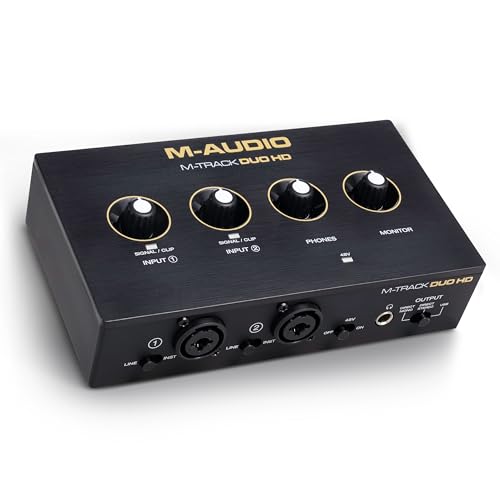
If you’re stepping into music production and need a reliable, high-quality audio interface, the M-AUDIO M-Track Duo HD stands out as an excellent choice. This 2-in/2-out USB-C interface supports 24-bit/192kHz audio resolution, ensuring studio-quality sound for your recordings. With two combo inputs and a headphone output featuring independent level control, you can easily connect microphones or instruments. Enjoy zero-latency monitoring and crystal-clear preamps that capture every sound detail. Plus, it comes with a software bundle that includes Ableton Live Lite and a 2-month Splice subscription, making it perfect for enhancing your creative process on the go.
Best For: The M-AUDIO M-Track Duo HD is best for beginner and intermediate music producers seeking a versatile and portable audio interface for recording, streaming, and podcasting.
Pros:
- Supports high-resolution 24-bit/192kHz audio for studio-quality sound.
- Compact and lightweight design, perfect for both home and on-the-go use.
- Comes with a comprehensive software bundle, enhancing creative possibilities.
Cons:
- Limited to 2 inputs/outputs, which may not suffice for larger recording setups.
- The software bundle may not include advanced features found in more expensive DAWs.
- USB-C connectivity may require adapters for compatibility with older devices.
PreSonus Studio 24c USB Audio Interface

For aspiring musicians and producers looking to kickstart their music production journey, the PreSonus Studio 24c USB Audio Interface offers a perfect blend of quality and accessibility. With a 192 kHz sampling rate and 24-bit resolution, you’ll capture every detail of your sound. It features two XMAX-L mic preamps for versatile input options and balanced outputs for studio monitors. The high-power headphone output and low-latency monitoring make tracking a breeze. Plus, it comes with Studio One 6 Artist Edition, ensuring you have the tools to start creating right away. Connectivity is seamless with included USB-C cables for most computers.
Best For: Aspiring musicians and producers seeking a high-quality, accessible audio interface for their music production needs.
Pros:
- High-quality audio with a 192 kHz sampling rate and 24-bit resolution for detailed sound capture.
- Versatile connectivity with two XMAX-L mic preamps and balanced outputs for studio monitors.
- Included Studio One 6 Artist Edition software provides essential tools for music creation right out of the box.
Cons:
- Limited I/O options with only 2 inputs and 2 outputs, which may not be sufficient for larger setups.
- No onboard effects or processing, which means users need to rely on software for sound manipulation.
- Potential compatibility issues with older computers that lack USB-C ports, despite included adapters.
MAONO Podcast Equipment Bundle: Audio Interface Mixer for Podcast Streaming

Looking for a versatile audio solution that suits both podcasting and streaming? The MAONO Podcast Equipment Bundle offers an upgraded E2 Gen2 audio interface mixer, perfect for your needs. With two XLR combo inputs featuring high-quality preamps, you’ll get a rich sound, while noise reduction technology guarantees clarity. Customize your content with eight sound effect buttons and enjoy features like a one-touch mute and loopback function for seamless streaming. Plus, it’s compatible with multiple devices and comes with all necessary cables. This bundle simplifies your audio experience, making it an excellent choice for beginners diving into podcasting or streaming.
Best For: Beginners and content creators looking for an all-in-one audio solution for podcasting and streaming.
Pros:
- High-quality preamps provide rich and clear sound for optimal audio quality.
- Customizable sound effects and features enhance engagement during recordings.
- Portable with a built-in battery, allowing for up to 8 hours of use.
Cons:
- Limited sound effect recording time (up to 20 seconds per button).
- May require additional setup for advanced users seeking more complex audio configurations.
- No support for phantom power, which limits the use of certain types of microphones.
2i2 USB-C Audio Interface for PC/Mac Recording

The 2i2 USB-C Audio Interface stands out as an ideal choice for aspiring musicians and content creators seeking professional-grade recording capabilities without the steep learning curve. With its dual TS/XLR inputs and +48V phantom power, you can easily connect a condenser mic or your guitar. The plug-and-play setup for PC and Mac eliminates the hassle of drivers, allowing you to focus on your creativity. Enjoy crystal-clear 24-bit/192kHz audio quality, thanks to transparent preamps. Plus, the dedicated controls for monitoring and mixing make it intuitive. Its compact, durable design guarantees you can take it anywhere, supported by professional assistance whenever needed.
Best For: Aspiring musicians and content creators looking for professional recording capabilities without complex setup.
Pros:
- Plug-and-play setup for both PC and Mac, eliminating the need for drivers.
- High-quality audio with 24-bit/192kHz resolution and transparent preamps.
- Durable and compact design, making it easy to transport for on-the-go recording.
Cons:
- Limited to two inputs, which may not be sufficient for larger recording setups.
- Requires an additional USB power adapter for independent power.
- Some users may prefer more advanced features for complex audio projects.
HOSONGIN 2i2 USB Audio Interface for Beginners
Offering studio-quality recording in a compact design, the HOSONGIN 2i2 USB Audio Interface is perfect for podcasters, musicians, and content creators who want professional sound without the hassle of complex equipment. With 24-bit/192kHz resolution, you’ll enjoy clear recordings right away. Its plug-and-play setup lets you start recording in just 60 seconds—simply connect via USB, plug in your mic or guitar, and go. Plus, it features phantom power for condenser mics and zero-latency monitoring. Built to last, this durable interface grows with your skills, making it an ideal choice for aspiring creators ready to build their audience.
Best For: Aspiring podcasters, musicians, and content creators seeking high-quality audio recording without complex equipment.
Pros:
- Plug-and-play functionality allows users to start recording in just 60 seconds.
- Phantom power supports professional condenser microphones for enhanced sound quality.
- Durable metal chassis ensures longevity and reliability in various environments.
Cons:
- Limited to two inputs, which may not be sufficient for larger recording setups.
- May require additional accessories, such as a microphone and cables, for complete functionality.
- Beginners may still need to learn basic audio recording techniques for optimal use.
Factors to Consider When Choosing Beginner Audio Interfaces
When choosing a beginner audio interface, you’ll want to contemplate several key factors to guarantee it suits your needs. Think about audio quality standards, input options, and software compatibility, as these can greatly affect your music production experience. Don’t forget to evaluate monitoring features and the interface’s portability and design for ease of use.
Audio Quality Standards
Choosing a beginner audio interface can be overwhelming, especially since audio quality standards play an essential role in your music production experience. Aim for an interface with a 24-bit depth and sampling rates up to 192 kHz to achieve studio-quality sound. A dynamic range of at least 100 dB is critical for capturing both the quietest and loudest sounds without distortion. High-quality preamps are also important, particularly for microphones, as they enhance audio clarity. Look for zero-latency monitoring to get real-time feedback while recording, ensuring you hear your input without delays. Finally, having switchable phantom power (+48V) is necessary for using condenser microphones effectively, which require external power to perform at their best.
Input Options Variety
A solid beginner audio interface should provide a variety of input options to suit your recording needs. Look for models that feature combo XLR/line inputs, allowing you to connect different microphones and instruments easily. It’s also essential to choose an interface that offers phantom power, which supports condenser mics for added versatility. Dual inputs can be a game-changer, letting you record vocals and guitar simultaneously for richer creativity. High-headroom inputs help prevent clipping and distortion, ensuring you capture a wide dynamic range without compromising quality. Additionally, dedicated instrument inputs for guitars or bass can enhance sound quality, eliminating the need for extra gear. Prioritizing these features will set you up for successful recordings.
Software Compatibility
To guarantee a smooth recording experience, it’s crucial to select an audio interface that’s compatible with popular digital audio workstations (DAWs) like Pro Tools, Ableton Live, or FL Studio. Check if the interface includes bundled software, as many models come with important recording and production tools that can enhance your creativity. Make sure the interface supports your computer’s operating system, whether it’s Mac or Windows, to prevent any installation hiccups. Look for plug-and-play functionality, which simplifies setup and often eliminates the need for additional drivers—perfect for beginners. Additionally, consider the availability of software plugins and effects that come with the interface, as they can greatly expand your audio production options and improve your recordings.
Monitoring Features
While monitoring features might seem like a minor detail, they play a vital role in your recording experience. Real-time audio feedback during recording is indispensable, allowing you to hear yourself without latency, which maintains your performance quality. Look for a headphone output with independent level control; this gives you the flexibility to adjust the volume to your liking without affecting the main output. An audio interface with a USB/Direct switch will guarantee zero-latency monitoring, keeping your sound in sync. Some interfaces include mixer knobs for low-latency direct input monitoring, helping you balance recorded audio and playback. Finally, having multiple monitoring output options, like stereo outputs for studio monitors and headphone outputs, enhances your overall listening experience.
Portability and Design
When choosing a beginner audio interface, portability and design are essential factors that can greatly enhance your recording experience. You’ll want a lightweight and compact interface to easily transport it for on-the-go recording sessions. A durable construction is key, as it can withstand the rigors of travel and everyday use. Look for USB connectivity, which is universally compatible with both Mac and PC, allowing for hassle-free connections without extra power sources. Additionally, choose an interface featuring user-friendly designs with clearly labeled controls and a simple layout to simplify your learning curve. A small footprint lets you fit the interface into various setups, whether you’re at home, in a studio, or during live performances.
Connectivity Types
Choosing the right connectivity type for your beginner audio interface is essential, as it directly impacts your recording workflow. Most beginner interfaces use USB connections, with USB-C becoming the standard for quicker data transfer and compatibility with modern devices. Look for plug-and-play functionality, which allows you to connect directly to your computer without complicated setups or extra drivers. Some models also offer additional options like MIDI or 3.5mm ports, giving you versatility for various audio applications. Confirm the interface works with both Mac and PC for broader compatibility. Finally, zero-latency monitoring features let you listen to your recordings in real-time, enhancing your overall experience and making it easier to capture the perfect sound.
Budget Considerations
Understanding your budget is key to selecting the right beginner audio interface. Prices can range from around $50 to over $200, so it’s essential to align your budget with your recording needs. Many entry-level interfaces come with important features like high-quality preamps and software bundles, offering professional sound without a hefty price tag. Don’t forget to account for additional costs such as microphones, headphones, and software, which can add up quickly. Some budget interfaces deliver 24-bit/192kHz audio resolution, ensuring solid sound quality. Finally, consider investing a little more for better durability and features; as your skills develop, having a versatile interface will be beneficial for your evolving recording needs.