Choosing the best audio mixer for live bands means balancing channel capacity, hands-on control, output flexibility, and dependable performance under pressure. The right board should accommodate your microphones and instruments without making setup unnecessarily complicated.
These 10 mixers cover a range of live-use needs, from compact rehearsal and small-venue systems to digital remote mixing, multitrack recording, Bluetooth playback, and streaming.
Best 10 Audio Mixer for Live Bands Picks for 2026
Best Remote-Controlled Mixer

- Remote control from up to 10 devices
- Built-in dbx, DigiTech, and Lexicon processing
- 16 inputs with four Aux outputs
Best For: Bands needing flexible remote mixing and monitor control
Best Mixer-Recorder Combo

- 12 channels and 14-track SD recording
- 32-bit float clip-free recording on four inputs
- Battery, USB, or mobile-pack power
Best For: Portable live performance recording and mixing
Best Simple Analog Mixer

- D-PRE preamps with three-band EQ
- One-knob compressors for quick control
- Rugged metal chassis and 48V phantom power
Best For: Small bands wanting dependable hands-on analog mixing
Best Budget Feature Mixer
FULUODE CT-80S 8-Channel Mixer

- Bluetooth, MP3 playback, and USB recording
- Reverb, echo, and 48V phantom power
- Slim eight-channel design
Best For: Small performances, karaoke, and multipurpose live setups
Best Feature-Rich Pick

- 12 mic inputs plus two stereo channels
- 99 DSP effects and 7-band main-output EQ
- USB recording, Bluetooth, and per-channel phantom power
Best For: Larger live-band setups needing extensive inputs and sound shaping
Best Compact Value

- Four XLR inputs with 48V phantom power
- 16 DSP effects and 3-band EQ
- USB playback/recording and Bluetooth streaming
Best For: Small bands and compact karaoke or recording setups
Best Monitoring-Friendly Option

- Eight inputs with XLR and 1/4-inch connectivity
- PFL headphone monitoring and LED peak indicator
- USB, Bluetooth, reverb, and delay effects
Best For: Small-to-midsize bands needing monitoring and versatile connections
Flexible Stage Control
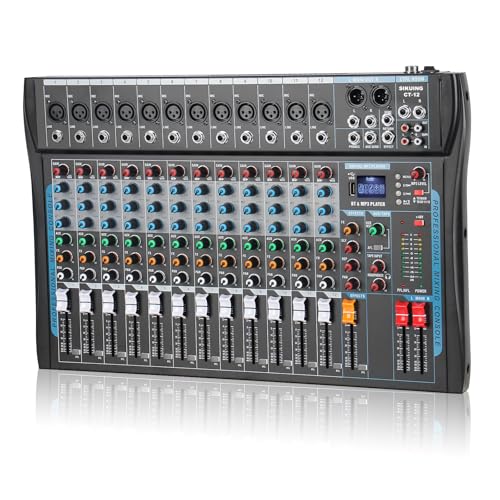
- 12 mic inputs for larger setups
- Bluetooth, USB, and 16-DSP effects
- 3-band EQ and +48V phantom power
Best For: Live bands needing multiple inputs and flexible playback or recording
Live-Gig Workhorse

- Eight channels for compact band setups
- USB, Bluetooth, MP3, and flash support
- 3-band EQ and stereo output metering
Best For: Small-to-mid-sized gigs, rehearsals, and karaoke
Compact Band Companion

- Three XLR inputs for small setups
- Echo, delay, USB, and Bluetooth features
- Headphone monitoring and phantom power
Best For: Small bands, acoustic acts, and portable recording setups
Best Remote-Controlled Mixer – Soundcraft Ui16
For bands that want flexible control from anywhere in the venue, the Soundcraft Ui16 is a strong audio mixer for live bands. Its rack-mountable design, remote operation, onboard processing, and broad I/O make it practical for detailed live sound management.
Best For: Live bands needing wireless or wired control, multiple monitor mixes, and built-in signal processing.
Pros:
- Controls can be accessed from up to 10 phones, tablets, or computers.
- Includes dbx, DigiTech, and Lexicon processing, plus three Lexicon FX buses.
- Offers eight XLR combo inputs, four XLR mic inputs, instrument inputs, and balanced outputs.
- Provides four balanced XLR Aux outputs and direct USB playback and recording.
Cons:
- Requires a separate control device because the mixer is remotely operated.
- Its feature set may be more than a small, simple setup needs.
The Ui16 is a versatile choice when remote mixing and extensive output control matter more than a traditional hands-on surface.
Best Mixer-Recorder Combo – Zoom LiveTrak L6max
The Zoom LiveTrak L6max combines mixing and multitrack recording in a compact unit, making it a useful audio mixer for live bands that also want to capture performances. It provides 12 channels, 14-track recording, battery operation, and modern noise-reduction features.
Best For: Musicians who need portable live mixing and multitrack recording for rehearsals, performances, or mobile sessions.
Pros:
- Records up to 14 tracks simultaneously to SD cards up to 2TB.
- Four combo inputs include Hi-Z, alongside eight line inputs.
- 32-bit float recording with dual converters helps manage extreme dynamics on channels 1–4.
- Runs on AA batteries, USB bus power, or a mobile battery pack.
Cons:
- Its 12-channel layout may not suit larger bands with extensive input needs.
- Battery-powered operation requires keeping batteries or a compatible power source available.
Choose the L6max if recording is as important as live mixing and you value a lightweight setup that can work away from wall power.
Best Simple Analog Mixer – Yamaha MG10
The Yamaha MG10 is a straightforward audio mixer for live bands that prefer dedicated controls without USB connectivity or built-in effects. Its D-PRE preamps, three-band EQ, high-pass filters, and one-knob compressors cover the core needs of vocals and instruments.
Best For: Small live bands wanting a durable, easy-to-use analog mixer with phantom power and basic dynamics control.
Pros:
- Studio-grade discrete Class-A D-PRE preamps provide a detailed signal path.
- Three-band EQ and high-pass filters help shape and clean up channels.
- One-knob compressors offer quick control for guitars, bass, snare, and vocals.
- Rugged powder-coated metal chassis is built for regular handling.
Cons:
- It has no USB connectivity or built-in effects.
- Its 10-input capacity may be limiting for larger ensembles.
The MG10 is a sensible pick for bands that want reliable analog operation and essential controls rather than recording or effects features.
Best Budget Feature Mixer – FULUODE CT-80S 8-Channel Mixer
The FULUODE CT-80S is a feature-focused audio mixer for live bands, karaoke, conferences, and small performance setups. It combines eight channels with Bluetooth, USB playback and recording, reverb, MP3 support, and 48V phantom power in a slim console.
Best For: Small bands and multipurpose performers who want Bluetooth, media playback, and vocal effects in one affordable-style mixer.
Pros:
- Supports eight channels for microphones and instruments.
- Includes built-in Bluetooth 5.0, MP3 playback, and USB recording.
- Provides reverb, echo, and 48V phantom power for compatible microphones.
- Thin 1.57-inch design suits space-conscious setups.
Cons:
- Eight channels may not provide enough capacity for larger bands.
- The supplied notes specify a 110V American plug, so power compatibility matters.
- Its feature set is oriented toward general-purpose use rather than advanced professional processing.
The CT-80S makes the most sense when convenience features such as wireless playback, karaoke support, and USB recording are priorities.
Best Feature-Rich Pick – 12-Channel Live Sound Mixer
This 12-channel console is a versatile audio mixer for live bands that need several microphone and stereo inputs, flexible EQ, and built-in effects. It combines per-channel controls with USB recording, Bluetooth playback, and a 7-band main-output EQ for more detailed live-sound adjustments.
Best For: Live bands, small venues, karaoke, meetings, and recording setups that need generous input capacity and extensive sound-shaping options.
Pros:
- 12 microphone inputs plus two stereo channels accommodate larger multi-source setups.
- Independent 48V phantom-power switches support condenser microphones on individual channels.
- Includes 99 DSP effects, channel mutes, USB recording/playback, and Bluetooth streaming.
- 7-band main-output EQ complements the 3-band EQ on each channel.
Cons:
- Its larger 12-channel layout may be more mixer than a small two- or three-piece group needs.
- Bluetooth range is listed at approximately 15 feet.
Choose this model when input flexibility and extensive onboard processing matter more than having the most compact setup. The independent phantom-power controls and output EQ are particularly useful when managing varied microphones and instruments during a live performance.
Best Compact Value – 6-Channel Bluetooth Mixer
This six-channel console is a practical audio mixer for live bands with modest input requirements. It provides four XLR inputs with 48V phantom power, stereo channels, 3-band EQ, 16 DSP effects, USB playback and recording functionality, and Bluetooth streaming in a relatively compact format.
Best For: Small live bands, karaoke, compact stage rigs, home recording, and performers who need basic mixing with wireless playback.
Pros:
- Four XLR inputs support condenser or dynamic microphones, while 1/4-inch inputs handle instruments and other sources.
- Offers 3-band channel EQ, gain controls, independent faders, and 16 built-in DSP effects.
- Bluetooth and USB functions support music playback, mixing, and recording.
- Includes 48V phantom power for the XLR input channels.
Cons:
- Six channels provide less expansion room than the 8- and 12-channel alternatives.
- The listed manufacturer warranty is 90 days.
- Its traditional analog operation may require careful setup to avoid operation-related audio issues.
This mixer makes sense for smaller groups that want essential live controls without moving to a larger console. Its input selection and built-in effects cover common vocal-and-instrument arrangements, while Bluetooth and USB add convenient playback options.
Best Monitoring-Friendly Option – 8-Channel Stage Mixer
This 8-channel console is a balanced audio mixer for live bands that need multiple inputs, straightforward channel control, and convenient monitoring. It supports XLR and 1/4-inch connections, adds USB and Bluetooth functions, and includes reverb and delay effects for live shows, streaming, and recording.
Best For: Small-to-midsize bands, live shows, streaming, weddings, karaoke, and users who want headphone monitoring and flexible media connections.
Pros:
- Eight channels provide room for multiple microphones and instruments.
- Each channel includes gain, FX, PFL, 3-band EQ, peak indication, and a volume fader.
- USB playback/recording and Bluetooth support phones, computers, flash drives, and other sources.
- Dedicated headphone monitoring and LED peak-level indication assist with live adjustments.
Cons:
- The notes do not specify the number of separate phantom-power switches or their per-channel control arrangement.
- It is corded and intended for powered setups rather than battery-powered operation.
Consider this model if monitoring and hands-on channel control are priorities. Its eight-channel capacity sits between the other options, while PFL headphone monitoring, independent controls, and USB/Bluetooth connectivity make it adaptable for stage and content-creation use.
Flexible Stage Control – 12-Channel Audio Mixer
For bands needing plenty of microphone capacity, this 12-channel audio mixer for live bands combines multiple inputs with Bluetooth, USB, onboard effects, and phantom power. Independent gain and volume controls, 3-band EQ, and LED indicators provide practical control for stage performances, recording, karaoke, and streaming.
Best For: Live bands and multi-microphone setups that also need Bluetooth or USB playback and recording.
Pros:
- 12 mic inputs with XLR and balanced line connections
- Built-in 16-DSP effects, 3-band EQ, and headphone monitoring
- Bluetooth and USB support for streaming, mixing, and recording
- +48V phantom power supports condenser microphones
Cons:
- The supplied notes do not specify the exact DSP effect selections
- Its larger channel count may be more than needed for small acoustic setups
This is the most expandable option of the three, especially when a band uses several microphones and instruments. Its compact, dust-resistant chassis and broad connectivity make it a versatile choice for stage and studio use.
Live-Gig Workhorse – Depusheng 8-Channel Mixer
This 8-channel audio mixer for live bands focuses on straightforward live sound control, with XLR and 1/4-inch inputs, 3-band EQ, Bluetooth, USB, and multiple output options. Its peak indicators and stereo output meter help monitor levels during gigs, rehearsals, DJ events, and karaoke.
Best For: Small-to-mid-sized live performances where easy controls and broad device compatibility matter.
Pros:
- Eight channels with XLR and unbalanced 1/4-inch inputs
- USB, flash reader, MP3, and Bluetooth connectivity
- 3-band EQ on all channels with accurate LED level metering
- +48V phantom power for compatible condenser microphones
Cons:
- It has fewer channels than the 12-channel alternative
- The supplied notes do not identify onboard reverb or other effects
- The listed dimensions appear inconsistent, so verify sizing before purchase
The DX8 is a practical middle-ground mixer for bands that need more than a compact mini console but do not require 12 channels. Its metering, outputs, and wireless playback support are well suited to regular live use.
Compact Band Companion – BOMGE 5-Channel Mixer
For a small setup, this five-channel audio mixer for live bands offers three XLR inputs, stereo line connections, Bluetooth, USB playback and recording, and built-in echo or delay. Its compact format and headphone monitoring make it convenient for small band shows, streaming, podcasting, and home recording.
Best For: Small bands, acoustic acts, and creators who want a portable mixer with vocal effects and basic recording features.
Pros:
- Three XLR inputs plus stereo 6.35mm and RCA line inputs
- Echo and delay effects with gain and 2-band EQ controls
- USB-B recording interface, USB-A playback, and Bluetooth streaming
- Headphone monitoring and +48V phantom power are included
Cons:
- Only three XLR inputs limit larger band configurations
- Bluetooth works within the stated 1.5-foot range
- Bluetooth, USB, and 4/5-channel functions cannot be used simultaneously
The BM-05 is best viewed as a compact, feature-rich option rather than a full-size band console. It makes sense when portability, simple vocal effects, and USB recording outweigh the need for numerous microphone channels.
How We Picked the Best Audio Mixer for Live Bands
We focused on the features that matter most during rehearsals, gigs, worship services, club shows, and mobile performances. Our selection considers input count, microphone connectivity, phantom power, EQ and effects, monitor and main outputs, USB or recording functions, portability, and ease of operation. We also included both traditional analog mixers and digital or hybrid designs so different types of bands can find a practical fit.
Because specifications and bundled accessories can vary by seller, confirm the current listing before buying—especially channel layouts, USB recording capabilities, app support, and included power supplies.
Quick Comparison
| Best For | Recommended Mixer Type | What to Prioritize |
|---|---|---|
| Small bands and compact venues | 6- to 8-channel analog mixer | Mic inputs, phantom power, usable EQ, and low weight |
| Growing bands | 10- to 12-channel mixer | Extra inputs, monitor outputs, effects, and flexible routing |
| Remote or difficult-to-reach setups | Digital mixer | Wireless control, scene recall, and stable network operation |
| Recording after a performance | Mixer with USB or multitrack recording | Computer compatibility, playback, and file-handling features |
| Streaming and content creation | USB-equipped mixer | Simple routing, headphone monitoring, and reliable level control |
Key Buying Factors for an Audio Mixer for Live Bands
Input Count and Channel Layout
Count every source before choosing a mixer: lead vocals, backing vocals, guitar microphones, keyboards, drums, playback devices, and spare inputs. Leave room for expansion rather than selecting a board that is already full on day one. Also check whether the advertised channel count includes stereo channels or USB playback channels, which may not accept microphones.
Inputs, Phantom Power, and Gain Control
XLR microphone inputs are essential for most live vocal and drum setups. Selective 48V phantom power is useful when using condenser microphones or active direct boxes, while clean preamps and sufficient gain range help prevent noise. A high-pass filter can also reduce rumble and handling noise on vocal channels.
Outputs, Monitoring, and Effects
Look for a main stereo output plus dedicated monitor or auxiliary sends if performers need separate monitor mixes. Built-in reverb and delay can be convenient for vocals, but they should not replace good microphone placement and proper gain staging. Make sure the mixer provides the connectors your speakers, amplifiers, in-ear system, or powered monitors require.
Portability and Control
A lightweight analog board is often fastest to deploy, while a digital mixer can offer scene recall, deeper processing, and remote adjustment. Remote control is valuable when the mixer must sit near the stage or speakers, but it adds network and software considerations. For frequent travel, prioritize a sturdy chassis, clear controls, and a layout the operator can read in low light.
Who Should Buy Which Audio Mixer for Live Bands?
Choose a Compact Analog Mixer
Small bands, duos, solo performers, and rehearsal spaces should favor a straightforward 6- or 8-channel mixer with enough microphone inputs, phantom power, basic EQ, and a dependable main output.
Choose a Larger Analog or Hybrid Mixer
Full bands and small venues will benefit from 10 to 12 channels, extra routing, onboard effects, and USB playback or recording. This is a sensible middle ground when several musicians share one PA system.
Choose a Digital Mixer
Choose a digital model when you need remote control, saved settings, detailed processing, or flexible routing. It is especially useful for bands that perform regularly with the same setup, provided the operator is comfortable managing an app or network connection.
Choose a Recording-Ready Model
Musicians who want rehearsal captures, live demos, podcasts, or streams should prioritize USB audio, multitrack recording where available, headphone monitoring, and simple computer integration. Confirm whether the mixer records individual channels or only the final stereo mix.