Weighted keys can make practicing piano parts feel more familiar, but a weighted digital piano is not automatically a MIDI controller. Before buying, check both the key action and how the instrument connects to your recording setup.
These seven options cover portable keyboards and furniture-style home pianos. The buying guide below helps you narrow the field by space, playing needs, and MIDI compatibility.
Best 7 Midi Keyboards with Weighted Keys Picks for 2026
Best Desk-Style Piano
UISCOM 88-Key Weighted Digital Piano

- 88 weighted keys with MIDI control
- Includes a three-pedal system
- Wooden desk-style cabinet
Best For: Home practice with a furniture-style piano and MIDI
Best Wireless MIDI Option
STRICH SDP-120 Weighted Digital Piano

- Wireless MIDI and USB connectivity
- 88 fully weighted keys
- 128 tones and two 15W speakers
Best For: Standalone practice and flexible MIDI connections
Best Sound Selection
Donner DEP-20 Weighted Digital Piano
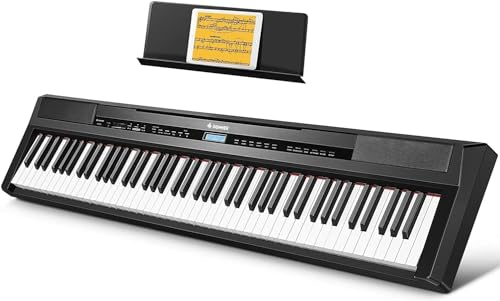
- 88 hammer-action keys
- 238 onboard tones
- Includes a sustain pedal
Best For: Beginners exploring a wide range of sounds
Best Home Practice Bundle
Eastar EUP-100 Weighted Digital Piano

- 88 weighted hammer-action keys
- Wireless MIDI and three pedals
- Headphones and cover included
Best For: Beginners setting up a dedicated home practice space
Best for Piano Fundamentals
Yamaha P71 88-Key Digital Piano

- 88 weighted, touch-sensitive keys
- 10 voices with Dual Mode layering
- Sustain pedal and power supply included
Best For: Piano-focused practice with simple controls
Best Desk-Convertible Design

- 88 hammer-action keys
- Converts into a work desk
- 800 tones and USB/MIDI connectivity
Best For: A combined piano and desk for a compact room
Best Feature-Rich Practice Set

- 88 weighted keys with adjustable response
- 185 tones and 116 rhythms
- Stand, sustain pedal, and three-pedal unit included
Best For: Home practice with varied sounds and accessories
Best Desk-Style Piano – UISCOM 88-Key Weighted Digital Piano
Among midi keyboards with weighted keys, the UISCOM stands out for its wooden desk-style cabinet and three-pedal setup. Its 88-key weighted keyboard supports MIDI control of a computer or other MIDI equipment, while eight onboard tones cover standalone practice.
Best For: Home players who want a weighted digital piano with MIDI functionality and a furniture-style design.
Pros:
- 88 weighted keys with adjustable key sensitivity.
- Includes sustain, sostenuto, and soft pedals.
- Dual headphone jacks and onboard recording and playback.
Cons:
- Only eight onboard tones, fewer than the other models here.
- Corded power and desk-style construction are geared toward a fixed home setup.
Choose this if the cabinet and complete pedal setup matter as much as MIDI control; look elsewhere if a broader sound library is your priority.
Best Wireless MIDI Option – STRICH SDP-120 Weighted Digital Piano
The STRICH SDP-120 is a flexible pick among midi keyboards with weighted keys if you want both wireless MIDI and USB connectivity. It pairs an 88-key fully weighted keyboard with onboard speakers, a sound library, and an LCD display.
Best For: Players who want a weighted piano for standalone practice and wireless or wired MIDI setups.
Pros:
- Fully weighted 88-key design and included sustain pedal.
- Wireless MIDI plus USB and MIDI connections.
- 128 tones, 200 rhythms, and two 15W speakers.
Cons:
- Includes a sustain pedal rather than a three-pedal unit.
- Requires corded power.
Its connectivity and built-in sounds make it a practical all-rounder. If three-pedal technique is essential, factor in the single included pedal.
Best Sound Selection – Donner DEP-20 Weighted Digital Piano
For shoppers comparing midi keyboards with weighted keys, the Donner DEP-20 offers an 88-key hammer-action keyboard and a particularly broad selection of onboard sounds. Its adjustable touch response and recording mode also support practice and experimentation.
Best For: Beginners who want a weighted keyboard with lots of instrument voices for practice and arranging.
Pros:
- 88 full-size hammer-action keys with adjustable touch response.
- 238 tones, dual-tone mode, and 128-note maximum polyphony.
- Includes a sustain pedal, music stand, and power adapter.
Cons:
- The included pedal is a sustain pedal, not a three-pedal unit.
- The supplied connectivity details do not clearly specify a USB-MIDI connection; confirm the required DAW hookup before buying.
The DEP-20 is compelling for its playing feel and sound variety. If connecting to a computer is your main goal, verify that its available ports match your setup.
Best Home Practice Bundle – Eastar EUP-100 Weighted Digital Piano
The Eastar EUP-100 combines the feel of an 88-key weighted hammer-action piano with wireless connectivity and MIDI IN/OUT. For buyers considering midi keyboards with weighted keys, its retro-wood desk design and included practice accessories make it especially suited to a permanent home spot.
Best For: Beginners who want a furniture-style piano with wireless MIDI and a ready-to-use practice bundle.
Pros:
- 88 weighted hammer-action keys and a three-pedal system.
- Wireless connectivity, MIDI IN/OUT, and recording.
- Includes headphones, piano stickers, and a protective cover.
Cons:
- At 25 kg, it is less convenient to move than a portable keyboard.
- The cabinet requires assembly; the supplied guidance suggests two people.
This is a strong fit for a dedicated practice space, especially if you want pedals and headphones included. Its weight and assembly make it less appealing for frequent moves.
Best for Piano Fundamentals – Yamaha P71 88-Key Digital Piano
Among midi keyboards with weighted keys, the Yamaha P71 is a straightforward choice if piano feel matters more to you than a large sound library. Its 88 touch-sensitive, weighted keys and built-in speakers let you practice without setting up a computer.
Best For: Pianists who want an acoustic-style playing feel and simple controls, with USB connectivity available for a computer setup.
Pros:
- Full-size weighted action supports expressive playing.
- 10 voices include a Yamaha grand piano sound; Dual Mode layers two voices.
- Sustain pedal and power supply are included.
Cons:
- Only 10 voices, fewer than the other options here.
- One-button operation offers a streamlined approach rather than an extensive control panel.
The P71 makes sense when your priority is practicing and recording piano parts on familiar-feeling keys. Choose another option if you want more built-in tones or rhythms.
Best Desk-Convertible Design – KU-1181 88-Key Digital Piano
If you’re comparing midi keyboards with weighted keys for a small home workspace, this KU-1181 pairs an 88-key hammer-action piano with a desk-convertible cabinet. Its USB/MIDI connection gives you a way to link it with a computer, while the built-in tones offer plenty to explore away from one.
Best For: Players who want a weighted digital piano that can also serve as a desk in a home office, dorm, or apartment.
Pros:
- Full-size, 88-key hammer-action keyboard.
- 800 tones, 128-note polyphony, and recording and split functions.
- USB/MIDI connectivity and a flip key cover; pedal and power adapter are included.
Cons:
- At 53 inches wide, it needs room even when used as a desk.
- Its cabinet and legs are less suited to frequent moves than a standalone keyboard.
The desk conversion is the reason to pick this model: it puts a piano and a work surface in the same footprint. Check that its dimensions suit your space before committing.
Best Feature-Rich Practice Set – Donner DEP-20 Lite
The Donner DEP-20 Lite is one of the midi keyboards with weighted keys to consider if you want practice features alongside a piano-style touch. It combines 88 hammer-action keys with adjustable response, built-in speakers, an LCD, and USB-MIDI connectivity.
Best For: Beginners and home players who want a weighted-key setup with varied sounds, rhythms, and included accessories.
Pros:
- Full-size weighted keys with adjustable touch response.
- 185 tones, 116 rhythms, and 128-note maximum polyphony.
- Dual 25W speakers, wireless connectivity, and USB-MIDI support.
- Set includes a stand, sustain pedal, and three-pedal unit.
Cons:
- Its many sounds and settings may be more than you need for basic piano practice.
- At 29.8 pounds, the keyboard still takes some effort to move.
This set offers more room to experiment than a piano-focused model, without giving up weighted keys. It is a practical pick if you expect to use its rhythms, connections, and bundled pedals rather than just its piano sound.
How We Picked the Best Midi Keyboards with Weighted Keys
We focused on the seven selected 88-key digital pianos and compared the features most relevant to piano-style playing and potential MIDI use: weighted action, portability, included accessories, built-in speakers, and connection requirements. Product names alone cannot establish the quality of an action or confirm a particular MIDI port, so check the current listing and manual before purchasing.
Quick Comparison
Start with where the keyboard will live. The UISCOM and the unnamed desk-style digital piano suit buyers looking for a home setup rather than a carry-to-rehearsal instrument. The STRICH and Eastar are other home-piano options to compare if speakers and included accessories matter. The Yamaha P71 and Donner DEP-20 are worth considering when a more portable format is the priority; the DEP-20 Lite bundle also lists a stand and sustain pedal. Compare the exact package contents, dimensions, and connections before treating any two offers as equivalent.
Key Buying Factors for Midi Keyboards with Weighted Keys
Verify MIDI Connectivity First
Most products here are marketed as digital pianos, not dedicated Midi Keyboards with Weighted Keys. If you plan to control virtual instruments, confirm that the exact model supports MIDI over USB or through MIDI ports. A USB connection used only for another purpose does not meet that need. Also check compatibility with your computer, tablet, and recording software, and whether an adapter or MIDI interface is required. Built-in speakers are useful for standalone practice but do not replace MIDI output.
Choose the Right Action
“Weighted” is a broad description. Hammer-action keys aim for a more acoustic-piano-like feel, while different weighted actions can vary substantially in resistance and response. If possible, play the instrument before buying; otherwise, look for a clear explanation of the action and a return policy that gives you time to assess it. All seven selections are listed as full-size 88-key instruments, which provides room for two-handed piano repertoire but requires more space than a smaller controller.
Check the Setup, Not Just the Keyboard
Measure your available width and consider whether you need a portable stand or a fixed desk-style cabinet. Verify what is included: a sustain pedal, stand, bench, and power supply are not interchangeable extras. Players practicing traditional piano technique may also want to check support for a compatible multi-pedal unit. For software use, plan for a stable stand and a suitable computer connection.
Who Should Buy Which Midi Keyboards with Weighted Keys?
Choose a desk-style option if it will stay in one room and furniture-like presentation matters. Start with the Yamaha P71 or Donner DEP-20 if you want to compare less furniture-oriented setups, and check the DEP-20 Lite package if an included stand would simplify your purchase. Consider the STRICH or Eastar when you want to compare home-practice features and bundled accessories. If MIDI control is the main reason you are shopping, make verified MIDI output and software compatibility your deciding criteria—not the word “weighted” in the title.