A good pop filter can make spoken-word recordings sound cleaner by reducing harsh bursts of air from sounds such as “P” and “B.” The right design also helps protect a microphone from moisture and breath during close-range use.
This roundup compares 10 microphone pop filters, including metal-mesh shields, layered screens, foam windscreens, and Blue Yeti-compatible options, so you can match the filter to your microphone and recording setup.
Best 10 Microphone Pop Filters Picks for 2026
Best All-Around Fit
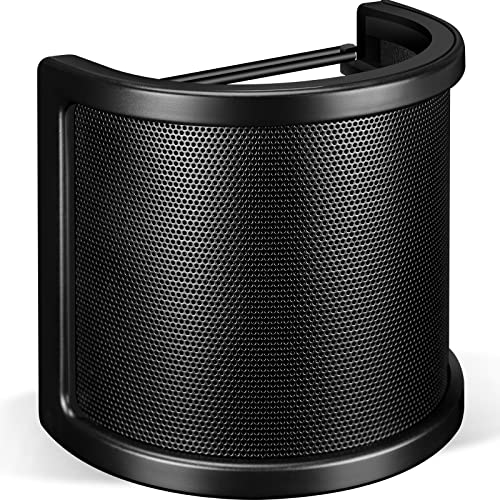
- Three-layer design reduces plosives and breath noise
- Fits compatible microphones 45–63 mm in diameter
- Quick elastic-and-rubber installation
Best For: Vocal recording, streaming, and compatible studio microphones
Best Premium Metal Screen
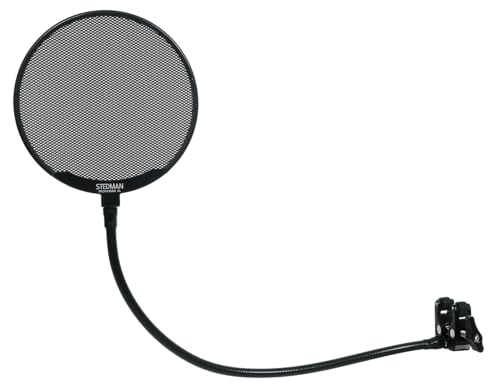
- Oversized 6.125-inch metal screen
- Reinforced 16.5-inch gooseneck resists sagging
- Clamp fits boom arms up to 1.5 inches wide
Best For: Studio, voiceover, podcasting, and streaming setups
Best Value Pack

- Includes five soft foam microphone covers
- Designed for standard handheld microphones
- Helps shield mics from saliva and moisture
Best For: Karaoke, interviews, conferences, and stage performances
Best Adjustable Setup

- Dual-layer screen disperses air pressure
- Flexible steel gooseneck supports precise placement
- Clamp fits various tubular booms and stands
Best For: Singers, streamers, and actors using mounted microphones
Blue Yeti Foam Cover
Washable Windscreen for Blue Yeti

- Designed for Blue Yeti and Yeti PRO
- May fit microphones up to 2.5 inches wide
- Washable foam helps reduce wind and unwanted noise
Best For: Blue Yeti voice and video recording setups
Three-Layer Pop Shield
Adjustable 360° Gooseneck Filter

- Three-layer screen supports plosive and noise control
- 360° filter and gooseneck adjustment
- Clamp mount with one-year warranty
Best For: Flexible vocal, streaming, and home recording setups
Blue Yeti Plosive Control
YOUSHARES Six-Layer Pop Filter

- Six-layer design helps reduce plosives and air noise.
- 360-degree gooseneck enables flexible positioning.
- Includes a Blue Yeti pop filter and foam windscreen.
Best For: Blue Yeti recording, streaming, and podcasting
Flexible Studio Shield
Professional Dual-Layer Pop Filter

- Helps reduce S-sound hissing and B/P plosives.
- 360-degree gooseneck supports flexible placement.
- Clamp and swivel mount simplify stand installation.
Best For: General microphone stands and home recording
Universal Mic Fit
PEMOTech Three-Layer Pop Filter

- Fits compatible microphones measuring 45–61 mm.
- Three-layer design targets plosives, breath, and wind.
- Elastic bands and rubber ring provide easy attachment.
Best For: AT2020, Rode, MXL, and other compatible studio microphones
Best All-Around Fit – Aokeo Three-Layer Mic Shield
If you need microphone pop filters for a compatible studio or streaming microphone, the Aokeo B-7 combines foam, metal mesh, and etamine layers to help reduce plosives, breath sounds, crackles, and wind interference. Its elastic-band and rubber-ring design is made for quick installation around microphones measuring 45–63 mm in diameter.
Best For: Vocal recording, YouTube videos, streaming, and compatible microphones such as the AT2020, AT2035, Rode NT1A, MXL 770, and BM-800.
Pros:
- Three-layer construction targets plosives, breath sounds, and wind interference.
- Helps keep saliva away from the microphone for easier maintenance.
- Quick to assemble and remove, with a firm elastic-and-rubber fit.
- Includes a stated two-year warranty.
Cons:
- Designed for microphones 45–63 mm in diameter, so compatibility must be checked.
- Specifically does not fit the Blue Yeti.
The Aokeo is a practical choice when you want a fitted microphone shield rather than a separate stand-mounted screen. Confirm your microphone’s dimensions before buying, especially if you use a Blue Yeti.
Best Premium Metal Screen – Stedman Proscreen XL V2
The Stedman Proscreen XL V2 is one of the microphone pop filters to consider when you want a large, durable metal screen and stable positioning. Its airflow-redirection design helps control “P” and “B” plosives while preserving vocal clarity, and the oversized screen covers a broad recording area.
Best For: Recording studios, voiceover work, podcasting, and streaming setups using a boom arm or stand up to 1.5 inches wide.
Pros:
- 6.125-inch metal screen provides broad vocal coverage.
- Designed to control plosives without reducing full frequency response.
- Reinforced 16.5-inch gooseneck is designed to resist sagging.
- All-metal, powder-coated construction is made in the USA.
Cons:
- Requires a suitable boom arm or stand for its clamp.
- Its metal construction may be more substantial than needed for simple handheld use.
Choose the Proscreen XL V2 when long-session stability and durable construction matter more than a compact design. The wide screen and tool-free clamp make it especially suitable for fixed studio and broadcast-style setups.
Best Value Pack – Mudder Five-Pack Foam Covers
For handheld microphones, these microphone pop filters are simple foam covers designed for quick replacement and basic protection. The five-pack uses soft, elastic foam to help shield microphones from saliva and moisture during karaoke, interviews, conferences, and stage performances.
Best For: Standard handheld microphones used in KTV, news interviews, conference rooms, dance events, and live stage performances.
Pros:
- Five covers provide convenient spares for repeated use.
- Soft, thick foam has elasticity for a snug fit.
- Helps keep handheld microphones away from saliva and moisture.
- Suitable for many standard handheld microphone sizes.
Cons:
- Not intended for headset microphones.
- Covers arrive compressed and need time to regain their shape.
- Foam covers are less suited to studio boom-arm positioning than mounted filters.
The Mudder pack is a budget-friendly option for event and handheld-mic users who prioritize hygiene and replacements. Allow the covers to expand before fitting them, and verify your microphone’s dimensions.
Best Adjustable Setup – NEEWER Dual-Layer Pop Filter
The NEEWER Professional Microphone Pop Filter is a versatile choice among microphone pop filters when you want adjustable placement on a boom or stand. Its dual-layer design disperses air pressure between screens to help contain plosives, while the steel gooseneck lets you set the screen’s angle and distance from the microphone.
Best For: Singers, streamers, and actors using tubular boom arms or microphone stands in home or recording setups.
Pros:
- Dual-layer construction helps control air blasts from “B” and “P” sounds.
- Adjustable gooseneck supports flexible screen positioning.
- Rotating clamp with scratch-proof gripper fits various tubular mounts.
- Swivel mount supports straightforward installation and removal.
Cons:
- Microphone is not included.
- Clamp compatibility is described for tubular booms or stands, so mounting should be checked.
- It is a separate mounted filter rather than a fitted handheld cover.
The NEEWER is a strong fit for users who frequently adjust microphone position or recording distance. Its dual-screen layout and flexible gooseneck offer more placement control than a simple foam windscreen.
Blue Yeti Foam Cover – Washable Windscreen for Blue Yeti
This washable foam cover is a straightforward option among microphone pop filters for Blue Yeti owners. It is designed for the Blue Yeti and Yeti PRO, while also fitting some microphones up to 2.5 inches in diameter, depending on the model.
Best For: Blue Yeti, Yeti PRO, and compatible large-diameter microphones used for voice recording or video recording.
Pros:
- Specially designed for Blue Yeti and Yeti PRO microphones.
- May fit other microphones up to 2.5 inches in diameter.
- Washable foam construction helps reduce wind and unwanted noise.
Cons:
- Compatibility with other microphone models depends on their exact diameter and design.
- Foam covers do not offer the adjustable positioning of a mounted pop filter.
Choose this cover if you want a simple, lightweight windscreen that slips over a compatible microphone. It is especially practical for Blue Yeti setups where easy installation and a compact design matter.
Three-Layer Pop Shield – Adjustable 360° Gooseneck Filter
For flexible microphone pop filters, the Aokeo P10 combines a three-layer screen with a 360° adjustable gooseneck. Its clamp-based mount is designed to work with various microphone stands and lets you position the filter for recording, streaming, singing, or acting.
Best For: Singers, streamers, actors, and home recording users who want adjustable plosive and hiss control.
Pros:
- Three-layer screen helps control airflow and recording noise.
- Both the filter and steel gooseneck rotate 360° for positioning flexibility.
- Swivel mount supports easier installation, removal, and adjustment.
- Includes a clamp and mount, with a stated one-year warranty.
Cons:
- At 0.27 kg, it is heavier than a simple foam microphone cover.
- Its clamp requires a suitable stand or mounting surface.
The P10 is a versatile choice when placement control matters. Its multi-layer screen targets plosives from sounds such as “B,” “T,” and “P,” while the adjustable arm helps maintain a useful distance from the microphone.
Recording Isolation Shield – Foldable Acoustic Pop Shield
This Aokeo isolation shield takes a broader approach than basic microphone pop filters by combining a foam-lined acoustic front with a vented metal back plate. Its folding panels allow angle adjustment, and the shield can be mounted to a microphone stand or used on a suitable countertop or tabletop.
Best For: Vocal recording, singing, and gaming setups that need an acoustic shield around a condenser microphone.
Pros:
- Absorbing cotton insulation helps reduce sound reflections during recording.
- Foldable panels support angle adjustment and easier transport.
- Premium steel construction and high-quality screws are designed for durability.
- Can be mounted to a stand or fixed on a countertop or tabletop.
Cons:
- At 1.5 kg, it is substantially heavier than a foam cover or small pop screen.
- The microphone, headphones, and stand are not included.
- Its larger shield design needs more setup space than a conventional clip-on filter.
Consider this model when room reflections are as important as plosive control. The foldable construction adds portability, while the mounting options make it suitable for a range of recording arrangements, including compatible Blue Yeti and condenser microphone setups.
Blue Yeti Plosive Control – YOUSHARES Six-Layer Pop Filter
For Blue Yeti owners comparing microphone pop filters, this YOUSHARES model combines a six-layer filter with a foam windscreen to help reduce plosives, breath noise, dust, and saliva during voice recording, streaming, podcasting, and video work.
Best For: Blue Yeti users who want adjustable positioning and both a pop filter and foam cover in one package.
Pros:
- Six-layer construction uses metal mesh and high-density windproof sponge to address plosives and unwanted air noise.
- 360-degree carbon-steel gooseneck supports flexible angle and distance adjustments.
- L-style swivel clip is designed to attach securely to a stand or Blue Yeti microphone.
- Includes both a pop filter and a Blue Yeti foam windscreen.
Cons:
- Its compatibility focus is specifically the Blue Yeti rather than a broad range of microphones.
- The package includes one pop-filter set, not a microphone.
Choose this option when Blue Yeti compatibility and flexible placement matter more than a universal fit. The combined filter and windscreen also make it a practical two-piece upgrade for home recording setups.
Flexible Studio Shield – Professional Dual-Layer Pop Filter
This microphone pop filter is a straightforward shield for Blue Yeti and other microphones, using a dual-layer screen and flexible gooseneck to help reduce hissing, plosives, and saliva exposure during recording.
Best For: Home studios and general microphone setups that need a clamp-mounted filter with adjustable positioning.
Pros:
- Designed to address hissing from “S” sounds and plosives from “B” and “P” sounds.
- 360-degree flexible gooseneck allows convenient placement in front of the microphone.
- Adjustable clamp is intended to secure the filter to a microphone stand.
- Swivel mounting supports easier installation and adjustment.
Cons:
- The package includes the pop filter only; the microphone is not included.
- The supplied notes do not specify a microphone-size range or detailed filter materials.
This is a sensible pick if you want a simple, broadly positioned shield without a more elaborate multi-layer specification. Its main advantage is the flexible gooseneck and stand clamp combination.
Universal Mic Fit – PEMOTech Three-Layer Pop Filter
Among microphone pop filters for standard studio mics, the PEMOTech model stands out for its 45–61 mm fit range and three-layer construction. It is built to help reduce plosives, crackles, wind interference, and breath sounds for vocals, videos, and streaming.
Best For: Users with compatible 45–61 mm microphones such as AT2020, AT2035, Rode NT1A, MXL 770, and similar models.
Pros:
- Three layers combine foam, metal mesh, and etamine to address pops, breath sounds, and wind interference.
- Elastic bands and an inner rubber ring provide a tool-free attachment design.
- Metal mesh and plastic frame help keep saliva away from the microphone.
- Works with a wide selection of listed studio microphones, including AT2020 and Rode NT1A.
Cons:
- It is explicitly not compatible with the Blue Yeti.
- Fit is limited to microphones measuring approximately 45–61 mm in diameter.
- The package includes one pop filter and does not include a microphone.
For a compatible studio microphone, this filter offers a useful balance of broad fit support and layered plosive control. Verify your microphone’s diameter before buying, especially because Blue Yeti owners need a different option.
How We Picked These Microphone Pop Filters
We focused on practical differences that affect everyday recording: filter construction, compatibility, mounting method, coverage, adjustability, and intended use. The selection includes multi-layer pop screens for studio and streaming setups, compact foam covers for handheld microphones, and models designed specifically for the Blue Yeti.
Because microphone shapes and mounting systems vary, a filter that works well for a desktop condenser microphone may not be the best choice for a handheld mic. We therefore considered both universal designs and more specialized covers.
Quick Comparison
| Type | Best For | Main Advantage | Watch For |
|---|---|---|---|
| Metal or layered mesh screen | Recording, streaming, podcasts | Strong plosive control and adjustable positioning | Requires a stable mount and enough desk or stand space |
| Foam windscreen | Handheld microphones and compact setups | Lightweight, simple, and portable | Fit and acoustic coverage can vary by microphone |
| Blue Yeti-specific cover | Blue Yeti owners | Designed around the microphone’s shape | Less flexible for other microphones |
| Isolation shield with filter | Home studios | Combines vocal filtering with some rear-side reflection control | Bulkier and more demanding to position |
Key Buying Factors for Microphone Pop Filters
Filter Material and Layers
Metal mesh filters are durable and easy to clean, while foam windscreens are lightweight and useful for reducing wind and breath noise. Multi-layer designs combine materials to manage plosives without relying on a single barrier.
Compatibility and Fit
Check whether the product attaches to a microphone stand, boom arm, or the microphone body itself. Foam covers should match the microphone’s dimensions closely; a loose cover may slip, while an overly tight one can affect placement.
Adjustability and Stability
A flexible gooseneck makes it easier to position the screen between your mouth and the capsule. Look for a firm clamp or attachment point that stays in place when the stand moves.
Cleaning and Durability
Metal screens generally offer the easiest long-term maintenance. Foam covers are convenient but may collect moisture and should be replaced when they become compressed, damaged, or difficult to clean.
Who Should Buy Which Microphone Pop Filters?
Choose a layered metal-mesh model if you record podcasts, vocals, voiceovers, or livestreams and want adjustable positioning with durable construction.
Choose a foam windscreen if you use a handheld microphone, travel frequently, or need a fast, low-profile solution for casual recording and calls.
Choose a Blue Yeti-specific filter if the Blue Yeti is your primary microphone and you want a shaped cover or accessory with a straightforward fit.
Choose an isolation shield if you record in a reflective room and want additional rear-side absorption alongside pop protection. Position it carefully, since it cannot replace good microphone technique or room treatment.