A good channel strip can shape a microphone signal before it reaches your interface, mixer, or recorder. Models with built-in de-essers are especially useful for controlling harsh “s” and “sh” sounds while also handling gain, compression, gating, and tone.
We’ve gathered 10 options ranging from accessible voice processors to premium tube and all-analogue designs. The right choice depends on your microphone, workflow, available rack space, and how much hands-on control you want.
Best 10 Channel Strip with De Esser Picks for 2026
Best Overall Value

- Four built-in processors for vocal and instrument chains
- XLR, line input, insert, and loop-out connectivity
- Rack-mountable 1U design with LED metering
Best For: Home studios, streaming, and voiceover setups
Best Digital Connectivity

- Tube preamp for warmth and definition
- Integrated compressor, expander, gate, and de-esser
- ADAT, AES/EBU, S/PDIF, TOSLink, and USB outputs
Best For: Hybrid recording studios needing flexible digital I/O
Best Two-Channel Dynamics Unit

- Two channels with independent or stereo-linked operation
- De-esser offers male and female voice modes
- Includes side-chain I/O and peak limiting
Best For: Stereo recording, live sound, and flexible dynamics processing
Best Premium Preamp Design

- Class A mic/line preamp with transformer outputs
- Silk harmonic enhancement and onboard compression
- 8-segment LED metering in a mono channel strip
Best For: Engineers prioritizing premium analog preamp character
Tube Tone Classic

- Tube mic, instrument, and line preamp
- EQ plus optical compressor
- Single-channel design with 2-year warranty
Best For: Tube-based recording and integrated compression
Transformer-Controlled Utility

- Mic and instrument preamp
- Lundahl input and output transformers
- Compressor/limiter, 3-band EQ, and metering
Best For: Mono vocal and instrument front-end processing
Modern SSL Workflow

- All-analogue mic channel strip
- Inspired by the SSL 4000 Series
- Compact 1U format
Best For: SSL-style analogue vocal and mic recording
Clean Vocal Control

- Dedicated de-esser for vocal sibilance
- Mic/instrument preamp with compression and limiting
- 3-band EQ and output metering
Best For: Vocal recording chains needing integrated de-essing
Tube Tone and Dynamics
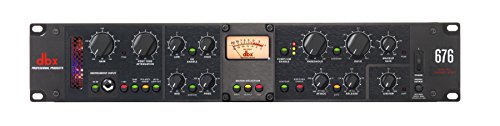
- 250-volt Class-A tube preamp
- Compressor/limiter with side-chain insert
- 3-band parametric EQ with sweepable mids
Best For: Tube-based recording chains prioritizing tone and dynamics
Flexible Tube Processing

- Mono tube channel strip with switchable mic impedance
- Selectable Opto and FET compression voicings
- 4-band semi-parametric EQ
Best For: Tube recording setups needing flexible compression and EQ
Best Overall Value – dbx 286s Channel Strip
The dbx 286s is a practical channel strip with de esser for vocals, instruments, streaming, and voiceover work. It combines a microphone preamp with compression, de-essing, enhancement, and expander/gate controls in a rack-mountable 1U unit.
Best For: Home studios, vocal chains, streaming setups, and users who want several essential processors in one affordable unit.
Pros:
- Includes compression, de-esser, enhancer, and expander/gate processing.
- Accepts microphone and line-level sources through XLR and 1/4-inch inputs.
- Loop-out and insert connections allow additional processors to be added.
- Status LEDs provide at-a-glance level and processor monitoring.
Cons:
- Provides one channel rather than stereo processing.
- Its analog, corded design may be less convenient for portable setups.
The 286s is a strong all-purpose choice when straightforward controls and broad vocal-processing options matter more than digital connectivity.
Best Digital Connectivity – ART VoiceChannel
The ART VoiceChannel is a tube-based channel strip with de esser processing and a broad selection of digital outputs. Its tube preamp is designed for warmth and definition, while compression, expansion, gating, and de-essing cover common recording needs.
Best For: Recording engineers who want tube coloration, integrated dynamics control, and flexible connections to digital studio systems.
Pros:
- Combines a tube preamp with compressor, expander, de-esser, and gate.
- Offers ADAT, AES/EBU, S/PDIF, TOSLink, and USB connectivity.
- Supports sample rates up to 192 kHz.
- Works with sources including guitar, bass, keyboard, and drums.
Cons:
- Its feature set may be more than needed for a simple analog vocal chain.
- The supplied notes identify it as a single-channel unit.
Choose the VoiceChannel when digital routing and tube-style preamp character are priorities alongside comprehensive dynamics processing.
Best Two-Channel Dynamics Unit – Behringer MDX2600
The Behringer Composer Pro-XL MDX2600 is a two-channel dynamics processor with de esser functionality, supplied here with a 10-foot XLR cable. It supports independent or stereo-linked operation and adds compression, expansion, gating, enhancement, and peak limiting for studio or live applications.
Best For: Users who need two-channel dynamics control, stereo linking, or flexible vocal sibilance reduction in a rack-based setup.
Pros:
- Provides independent or stereo-linked processing across two channels.
- De-esser includes switchable male and female voice detection modes.
- Side-chain input/output supports ducking and frequency-dependent processing.
- Includes tube simulation, dynamic enhancement, and peak limiting.
Cons:
- It is primarily a dynamics processor rather than a full microphone preamp channel strip.
- The supplied notes specify XLR connectivity but do not list digital outputs.
The MDX2600 is a sensible fit when channel count and advanced dynamics control are more important than an integrated preamp or digital interface.
Best Premium Preamp Design – Rupert Neve Newton
The Rupert Neve Designs Newton is a mono channel strip with a Class A mic/line preamp, custom transformer outputs, Silk harmonic enhancement, metering, and compression. The supplied notes do not list a dedicated de-esser, so it is better suited to buyers prioritizing premium preamp character and core channel processing.
Best For: Engineers seeking a high-end mono mic/line front end with transformer outputs, harmonic enhancement, and onboard compression.
Pros:
- Uses a Class A mic/line preamp design.
- Custom transformer outputs provide a specified analog output stage.
- Silk harmonic enhancement adds an additional tone-shaping option.
- Includes compression and 8-segment LED metering.
Cons:
- The supplied notes do not identify a dedicated de-esser.
- It is a mono channel strip, limiting simultaneous channel processing.
The Newton is the most specialized option here: a premium-focused preamp and channel strip for users who value analog character, while de-essing would require separate processing.
Tube Tone Classic – LA-610 Mk II
The Universal Audio LA-610 Mk II is a single-channel tube channel strip with de esser appeal for engineers who want microphone, instrument, and line preamplification alongside optical compression and EQ. Its tube design and three-stage signal path make it a focused choice for shaping one source at a time.
Best For: Recording engineers seeking a tube preamp, EQ, and optical compressor in one mono channel.
Pros:
- Combines vacuum-tube microphone, instrument, and line preamp functions.
- Includes EQ and an optical compressor for integrated tone shaping.
- Includes a 2-year warranty.
Cons:
- Provides only one channel.
- At 15.7 pounds, it is relatively substantial for a single-channel unit.
- The supplied specifications do not confirm a dedicated de-esser section.
The LA-610 Mk II is a strong fit when tube character and optical compression matter more than having multiple channels or confirmed dedicated de-essing. Verify the control layout if de-esser functionality is essential to your setup.
Transformer-Controlled Utility – Track One MK3
The SPL Track One MK3 is a mono channel strip with de esser potential for detailed front-end processing. It combines a microphone/instrument preamp with Lundahl input and output transformers, a compressor/limiter, output metering, and a 3-band EQ.
Best For: Engineers wanting transformer-equipped preamplification and practical dynamics, EQ, and metering in one mono unit.
Pros:
- Features microphone and instrument preamp functionality.
- Uses Lundahl input and output transformers.
- Combines compressor/limiter, output metering, and 3-band EQ.
Cons:
- It is a mono channel strip.
- The supplied notes do not confirm a dedicated de-esser section.
- Its listed dimensions are 21.35 x 14.95 x 5.15 inches, so rack or desk space should be planned.
The Track One MK3 offers a broad set of core recording controls, especially for users who value transformer I/O and straightforward metering. If dedicated de-essing is a must-have, confirm the full control set before buying.
Modern SSL Workflow – Revival 4000
The Solid State Logic Revival 4000 is an all-analogue mic channel strip with de esser relevance for engineers pursuing the recognizable SSL 4000-style workflow. Its compact 1U format is designed around the sound and approach of the iconic 4000 Series.
Best For: Users who want a compact all-analogue mic channel strip inspired by the SSL 4000 Series.
Pros:
- Offers an all-analogue signal path.
- Draws on the iconic SSL 4000 Series design.
- Uses a compact 1U format.
Cons:
- The supplied notes do not list specific EQ, compressor, or de-esser controls.
- The product is described as a mic channel strip, so broader input functionality is not confirmed.
- The listed material type is plastic.
The Revival 4000 is the most targeted option here for an SSL-inspired analogue workflow in a compact format. Because the supplied specifications do not detail a dedicated de-esser, review the complete feature set if vocal sibilance control is central to your purchase.
Clean Vocal Control – SPL Track One MK3
The SPL Track One MK3 is a practical channel strip with de esser for vocal and instrument recording chains that need several core processors in one mono unit. It combines a mic/instrument preamp with compression/limiting, metering, a 3-band EQ, and dedicated de-essing.
Best For: Vocalists, voice-focused recording setups, and engineers who want integrated de-essing alongside basic dynamics and EQ.
Pros:
- Includes a dedicated de-esser for managing vocal sibilance.
- Combines mic/instrument preamp, compressor/limiter, EQ, and output metering.
- Provides a focused mono channel-strip workflow.
Cons:
- Its 3-band EQ is less extensive than a 4-band design.
- The unit weighs 10.26 pounds and has a relatively large footprint.
Choose the Track One MK3 when de-essing is a priority and you want the essential vocal-processing stages consolidated in a single channel strip.
Tube Tone and Dynamics – dbx 676FX Tube Channel Strip
The dbx 676FX is a rack-mountable tube channel strip with compressor and EQ, but it does not list a dedicated de-esser in the supplied specifications. Its 250-volt Class-A tube preamp, compressor/limiter, side-chain insert, and sweepable-mid 3-band parametric EQ make it suited to shaping tone and dynamics.
Best For: Engineers seeking tube coloration, flexible compression, and parametric EQ in a 2U rackmount format.
Pros:
- 250-volt Class-A tube preamp supports warm, clear, or dirty tones.
- Includes compressor/limiter and a side-chain insert for frequency control.
- Offers a 3-band parametric EQ with sweepable mids, plus XLR and 1/4-inch connectivity.
Cons:
- No dedicated de-esser is listed, so it is not a direct match for a channel strip with de esser.
- Its 13-pound, 2U chassis may require rack space and additional support.
The 676FX is a strong option when tube character and flexible tone shaping matter more than built-in de-essing; users focused on sibilance control may need an additional processor.
Flexible Tube Processing – ART Pro Channel III
The ART Pro Channel III is a mono tube channel strip with selectable compression voicings and a 4-band semi-parametric EQ. A dedicated de-esser is not included in the supplied notes, so it is better viewed as a flexible tube preamp and dynamics processor than a complete channel strip with de esser.
Best For: Recordists who want tube-based mono processing with switchable compressor character and broader EQ control.
Pros:
- Provides selectable Opto and FET compression voicings.
- Includes a 4-band semi-parametric EQ for detailed tonal shaping.
- Offers switchable microphone impedance for added preamp flexibility.
Cons:
- No dedicated de-esser is listed in the supplied specifications.
- Its 10.61-pound chassis has a sizable footprint.
The Pro Channel III fits buyers who value tube coloration, compressor choice, and four-band EQ control; add a separate de-esser if vocal sibilance management is essential.
How We Picked the Best Channel Strip with De Esser
We selected models based on the usefulness of their signal-processing sections, microphone preamp design, control layout, connectivity, and suitability for common recording and speech applications. The list includes dedicated vocal processors, full-featured mono channel strips, dual-channel compressors, tube units, and premium analogue designs.
Because specifications and included accessories can vary by seller, confirm the current package contents, warranty, and input/output configuration before ordering. A channel strip may include a de-esser without offering the same routing flexibility or tonal character as a dedicated vocal channel.
Quick Comparison
- Best for streaming and voice processing: dbx DBX286SV, with an accessible combination of preamp, compression, de-essing, enhancement, and expander/gate controls.
- Best for tube character: Universal Audio LA-610 Mk II or dbx DBX676FX, depending on the type of EQ and dynamics control you need.
- Best for premium studio tracking: Rupert Neve Designs Newton and SSL Revival 4000, which emphasize refined analogue tone and detailed control.
- Best for flexible project studios: ART VoiceChannel, ART Pro Channel III, and SPL Track One MK3 models.
- Best for two-channel compression: Behringer Composer Pro-XL MDX2600, particularly where dual-channel dynamics processing is useful.
Key Buying Factors for a Channel Strip with De-Esser
Signal Chain and Controls
Look at the full processing order and whether sections can be bypassed. A useful channel strip may combine a microphone preamp, high-pass filter, compressor, de-esser, EQ, gate or expander, limiter, and output stage. More controls provide flexibility, but simpler layouts can be faster for spoken-word work.
De-Esser Operation
Check whether the de-esser offers adjustable frequency, threshold, bandwidth, or amount controls. A fixed or simple design can still reduce sibilance, while a more adjustable section is better when working with different microphones and voices. Listen for dulling or lisping when applying heavy reduction.
Tube Versus Solid-State Character
Tube circuits can add warmth and harmonic color, while solid-state and all-analogue designs may provide a cleaner, more immediate response. Neither approach is universally better; match the unit to the microphone, room, and desired production style.
Connections and Workflow
Confirm whether the unit accepts microphone, line, and instrument-level sources, and check for inserts, line outputs, digital outs, and loop-through connections. Digital output can simplify integration with some interfaces, while a standard analogue output is more broadly compatible.
Rack Space and Gain Requirements
Verify the unit’s rack format and available depth. Dynamic microphones may need substantial clean gain, whereas condenser microphones require phantom power and careful level setting. A strong preamp should provide useful headroom without excessive noise.
Who Should Buy Which Channel Strip with De Esser?
Choose an accessible voice-focused processor if you record podcasts, livestreams, announcements, or home vocals and want several essential controls in one unit. A tube channel strip is a better fit when harmonic color and hands-on tracking decisions are central to your sound.
Project studios should prioritize versatile EQ, compression, routing, and broad input compatibility. Engineers building a premium front end may prefer a refined single-channel strip with extensive control and high-quality analogue circuitry. For stereo or multi-source setups, a dual-channel compressor can offer more practical value than a feature-heavy mono unit.
Before buying, identify the main source you will record, decide whether de-essing will happen during tracking or later in software, and make sure the strip’s outputs match your interface or mixer. Those checks usually matter more than simply choosing the model with the longest feature list.