Finding the right tube head for home recording is a balancing act: you want real tube feel, manageable volume, and enough versatility to track clean parts or saturated tones without fighting your room.
This roundup focuses on compact, recording-friendly options that make tube amp heads for home recording practical for everyday use, from low-watt class A designs to feature-rich heads with attenuation and line-out flexibility.
Best 10 Tube Amp Heads for Home Recording Picks for 2026
Compact 5W Tube Practice Head
Bugera T5 Infinium 5W Tube Head

- 5-watt Class A tube head
- Onboard reverb and two channels
- Compact and easy to place at home
Best For: home recording and quiet practice
Flexible 15W Small-Format Tube Head

- 1W/15W switch for home-friendly output
- Gain plus high/mid/low EQ controls
- All-tube build with 12AX7 and EL84 tubes
Best For: compact home recording with flexible tone control
Feature-Rich 20/4W Recording Head

- 20/4-watt tube head with power reduction
- Two Notes reactive load and virtual cabinets
- Two channels plus FX loop
Best For: direct recording and flexible home-studio use
Classic 15W Single-Channel Head

- 15-watt single-channel tube head
- Vintage-inspired Orange styling
- Metal enclosure for sturdy build feel
Best For: simple home recording and classic tone chasing
Premium All-Tube Class A

- 20W Class A all-tube head
- Two channels for flexible tracking
- Includes FS2-MINI and slip cover
Best For: Home recordists who want a dual-channel tube head with Class A feel
Compact British Rock Head

- 15W tube head with 7W switch
- 3-band EQ for tone shaping
- Warm, full-bodied classic rock voice
Best For: Players recording classic rock tones who want simple controls and compact power
Low-Watt Feature Packed

- 5W Class-A tube head
- MORPH EQ for USA/British tones
- Reverb and power attenuator included
Best For: Home recordists who want low-watt recording control with built-in tone shaping
Classic Dual-Channel Pick
Electro-Harmonix MIG-50 50W Tube Head

- 50-watt tube head with two channels
- Separate volume controls plus treble, middle, bass, and presence
- Bright/high-gain channel for more drive
Best For: Players who want a classic two-channel tube head for flexible home recording tones
Most Recording-Friendly Option
Peavey Invective MH 20/5/1W Tube Head
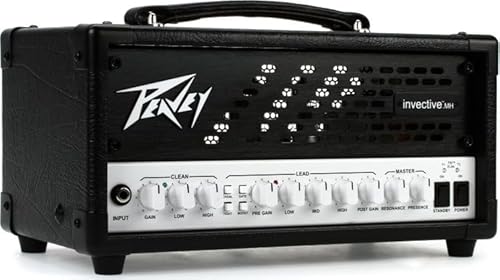
- 20/5/1-watt operation for lower-volume use
- Built-in noise gate and power attenuator
- Cab-simulated output for direct recording
Best For: Home recordists who want built-in tools for quieter tracking and direct output
Compact Modern Gain Choice
ENGL Fireball 25 25W Tube Head

- 25-watt tube head with two channels
- Built-in powersoak for volume control
- Buffered FX loop and mid boost
Best For: Players who want a compact modern tube head with useful home-recording volume control
Compact 5W Tube Practice Head – Bugera T5 Infinium 5W Tube Head
If you want tube amp heads for home recording without a lot of volume or footprint, the Bugera T5 Infinium is built around a simple 5-watt Class A design with onboard reverb. Its low-watt format and two-channel setup make it easier to capture tube feel in a home space while keeping the rig compact and straightforward.
Best For: Players who want a small tube head for home recording, practice, and occasional quiet tracking.
Pros:
- 5-watt Class A tube head keeps output modest for home use
- Onboard reverb adds built-in ambience without extra gear
- Two channels provide basic tone flexibility
- Compact, lightweight head design is easy to place in a studio
Cons:
- Only 5 watts, so it is not built for larger live setups
- Two-band EQ is simpler than more feature-rich heads
For a home-recording guitarist who values manageable power and built-in reverb, this head offers a practical tube option. It stays focused on the essentials rather than packing in extra routing or deep tonal controls.
Flexible 15W Small-Format Tube Head – OriPure OA-H15 15W Tube Head
For tube amp heads for home recording that still offer room to shape your tone, the OriPure OA-H15 gives you a 15W all-tube platform with 1W/15W switching. The gain and volume stages, plus high, middle, and low EQ, make it a practical choice when you want clear tones that can move into overdrive without a complicated layout.
Best For: Home recordists who want a compact tube head with flexible tone shaping and power reduction.
Pros:
- 1W/15W switch helps adapt output for home sessions
- Gain, volume, and 4-band EQ offer flexible control
- All-tube design uses 1 x 12AX7 and 2 x EL84 tubes
- 8Ω/16Ω output jacks add practical speaker compatibility
Cons:
- Single-channel design limits quick channel switching
- No built-in effects are listed
This head stands out if you want a small all-tube amp with more tone-shaping options than a bare-bones practice unit. The power switch and EQ controls make it well suited to dialing in recording tones at home.
Feature-Rich 20/4W Recording Head – Revv G20 20/4-Watt Tube Head
If you are comparing tube amp heads for home recording and want more built-in control, the Revv G20 combines a 20/4-watt tube platform with an embedded Two Notes reactive load and virtual cabinets. Its power-reduction circuit, 3 aggression levels, and two channels make it a strong fit for players who want recording flexibility in a compact head.
Best For: Recording players who want direct-friendly features and flexible wattage control in a tube head.
Pros:
- 20/4-watt operation supports more flexible home-volume use
- Embedded Two Notes reactive load and virtual cabinets aid recording workflows
- Two channels and 3 aggression levels expand tonal options
- FX loop adds extra rig integration
Cons:
- More feature-heavy than a simple grab-and-go practice head
- Plastic enclosure material is listed, not metal
The G20 is the most recording-oriented head in this group, especially if you value built-in virtual cab capability. It is a practical option when you want amp-head feel and modern home-studio tools in one package.
Classic 15W Single-Channel Head – Orange OR15 15W Tube Head
For tube amp heads for home recording with a straightforward, vintage-style approach, the Orange OR15 offers a 15W single-channel tube design in a metal enclosure. It keeps the layout simple and practical, making it a good match when you want a classic amp-head feel without extra switching or onboard features to manage.
Best For: Guitarists who prefer a simple, vintage-inspired tube head for home tracking.
Pros:
- 15-watt tube output suits smaller recording and practice setups
- Single-channel layout is simple to operate
- Metal enclosure gives it a sturdy feel
- Compact head format keeps the rig straightforward
Cons:
- No extra channels or onboard effects are listed
- Less flexible than multi-channel recording heads
The OR15 is a solid choice if you value simplicity and a classic Orange look over feature depth. For home recording, its appeal is in the direct, no-fuss tube format.
Premium All-Tube Class A – Laney Lionheart L20H
If you want tube amp heads for home recording with a little more headroom and a refined feel, the Laney Lionheart L20H is a strong fit. Its 20-watt Class A design, two channels, and hand-selected ECC83 and EL84 tubes give it a straightforward, studio-friendly feature set for tracking guitar parts at home.
Best For: Players who want a dual-channel tube head for home recording with Class A character and enough power to cover clean and driven parts.
Pros:
- 20 watts RMS offers more flexibility than low-watt practice heads.
- Two channels make it easier to switch between clean and dirty tones.
- Hand-selected ECC83 and EL84 tubes support its all-tube design.
- Includes an FS2-MINI footswitch and embroidered slip cover.
Cons:
- At 17.89 kg, it is not the lightest head to move around.
- Higher output may be more amp than some very quiet home setups need.
The L20H stands out if you want a recording head that feels more like a serious amp than a stripped-down bedroom tool. Its two channels and Class A tube layout make it a practical choice when you want one head to handle a range of home recording tones.
Compact British Rock Head – Orange OR15H 15W Tube Head
The Orange OR15H is a practical pick for tube amp heads for home recording if you want classic rock flavor in a compact format. Its 15-watt tube design, switchable 7-watt mode, and 3-band EQ make it easier to shape tones without adding a lot of complexity.
Best For: Guitarists who want a simple, warm, full-bodied tube head for recording classic rock-style parts at home.
Pros:
- 15 watts with a switchable 7-watt output for more flexible use.
- 3-band EQ helps you dial in the tone shape.
- Single-channel design keeps the layout simple and direct.
- Described as warm, full-bodied, and good at distorting nicely.
Cons:
- Single-channel operation offers less switching flexibility than multi-channel heads.
- No built-in effects are listed in the supplied details.
For home recording, the OR15H makes sense when you want a straightforward amp that leans into classic rock character. The lower-power option and simple control set make it easy to work with in a small studio or bedroom setup.
Low-Watt Feature Packed – Bugera G5 INFINIUM 5W Head
If you are shopping for tube amp heads for home recording and want lower wattage plus extra tone-shaping tools, the Bugera G5 INFINIUM is built for that role. Its 5-watt Class-A design, MORPH EQ, reverb, and power attenuator give it a versatile feature set for recording at manageable volume levels.
Best For: Home players who want a low-watt tube head with EQ morphing, reverb, and attenuation for flexible recording tones.
Pros:
- 5-watt Class-A design is well suited to home-level recording.
- MORPH EQ sweeps between USA and British-style tones.
- Built-in reverb adds ambience without extra gear.
- Power attenuator and dedicated reverb control increase flexibility.
Cons:
- Single-channel layout may feel limited if you need quick channel switching.
- Only one band is listed in the supplied details, so tone shaping is more specialized than on some rivals.
The G5 INFINIUM is a strong recording head if you want low wattage but still want room to experiment with tone. Its attenuation and MORPH EQ make it especially appealing for players who like to fine-tune sounds while keeping home volume under control.
Classic Dual-Channel Pick – Electro-Harmonix MIG-50 50W Tube Head
If you want tube amp heads for home recording with a straightforward, versatile platform, the Electro-Harmonix MIG-50 gives you a lot to work with. Its 50-watt tube design, dual channels, and separate volume controls make it easy to shape cleaner parts on channel 1 or push brighter, higher-gain tones on channel 2.
Best For: Players who want a simple, two-channel tube head with flexible controls for tracking clean and driven parts at home.
Pros:
- Two channels with separate volume controls for different recording tones
- Channel 2 adds a bright/high-gain option for more drive
- Treble, middle, bass, and presence controls help fine-tune the sound
- Tube-powered design with Sovtek 5881WXT power tubes
Cons:
- 50 watts may be more power than some home setups need
- No built-in recording-focused features like attenuation or cab simulation listed
For players who want a traditional tube head and plan to handle recording level control externally, the MIG-50 offers a practical, hands-on layout. It stands out more for its classic dual-channel flexibility than for modern studio convenience features.
Most Recording-Friendly Option – Peavey Invective MH 20/5/1W Tube Head
Among tube amp heads for home recording, the Peavey Invective MH is the most studio-friendly option here thanks to its built-in noise gate, power attenuator, and cab-simulated output. Its 20/5/1-watt operation gives you more control over volume, which is especially useful when you need usable tones without overpowering a room.
Best For: Home recordists who want built-in low-volume tools like attenuation and cab simulation.
Pros:
- 20/5/1-watt operation helps manage loudness at home
- Built-in noise gate supports tighter recorded tones
- Cab-simulated output is useful for direct recording workflows
- Clean and lead channels each have their own EQ approach
Cons:
- Listed output wattage of 1 watt may not reflect its full power options clearly
- Single output channel quantity may feel limiting for some setups
If your priority is recording at manageable levels with fewer external boxes, this Peavey head has the most practical feature set of the three. It combines attenuation and simulated output in a way that makes home sessions easier to control.
Compact Modern Gain Choice – ENGL Fireball 25 25W Tube Head
The ENGL E633 Fireball 25 is a compact tube head that makes sense for home recording if you want modern gain shaping in a smaller package. It offers two channels, a built-in powersoak, a buffered FX loop, and a mid boost, giving you useful control over both volume and tone while tracking.
Best For: Players who want a smaller 25-watt tube head with built-in power reduction and modern routing features.
Pros:
- 25-watt tube head is a practical middle ground for home use
- Built-in powersoak helps tame volume for recording
- Buffered FX loop adds flexibility for effects routing
- Mid boost can help the guitar sit forward in a mix
Cons:
- No cab-simulated output is listed
- Fewer recording-specific features than the Peavey option
This ENGL is a strong fit if you want a modern-feeling tube head with enough control to work in a home studio. It is less geared toward direct-output recording than the Peavey, but its powersoak and mid boost make it a capable tracking amp.
How We Picked the Best Tube Amp Heads for Home Recording
We focused on heads that make sense in a home studio: lower wattage or power-scaling options, usable master volume behavior, practical channel layouts, and features that help you capture usable tones without excessive volume. We also favored models with strong reputations for reliability and recording-friendly sound shaping.
Quick Comparison
In simple terms, the smallest heads are best for natural breakup at lower volume, while 15- to 25-watt models give more headroom, tighter low end, and broader genre coverage. If you want the most flexibility, choose a head with attenuation, multiple power settings, or a direct recording output.
Key Buying Factors for Tube Amp Heads for Home Recording
Wattage and Power Scaling
For home use, wattage matters less than how the amp behaves at lower volumes. A 5-watt head can still be loud in a bedroom, but it may deliver sweeter output-stage saturation sooner. Higher-power heads with switchable output or attenuation often give you more control and cleaner headroom when needed.
Master Volume and Gain Structure
A good master volume is crucial if you want usable tube tone without cranking the room. Look for amps that stay balanced at low settings and still respond well when you push the gain. This is especially important if you record late at night or share living space.
Voicing and Genre Fit
Some heads are geared toward vintage crunch, while others are built for modern high-gain tracking. Match the amp’s character to your usual workflow: blues, classic rock, indie, hard rock, or heavier styles. If you use pedals heavily, a simpler, cleaner platform may be the better choice.
Recording Features
For Tube Amp Heads for Home Recording, useful extras can include attenuators, speaker-emulated outputs, reverb, effects loops, and channel switching. These features do not replace good mic placement, but they can make setup faster and give you more consistent results.
Who Should Buy Which Tube Amp Heads for Home Recording?
If you want early breakup and a small footprint, choose a lower-watt model. If you need one amp for multiple styles, go with a head that offers power reduction or broader EQ control. Players chasing modern aggression should lean toward higher-gain designs, while those building tracks around pedals may prefer a more open, responsive platform. In short, the best choice depends on whether you value portability, flexibility, or a specific tonal flavor most.