If you’re looking to enhance your audio setup in 2025, you’re in for a treat. The latest audio interfaces bring cutting-edge technology right to your fingertips, ensuring you get exceptional sound quality for your recordings and streams. With so many options available, it can be overwhelming to choose the right one. So, what are the standout features that can help you elevate your sound quality? Let’s explore the top contenders.
Focusrite Scarlett Solo 4th Gen USB Audio Interface

The Focusrite Scarlett Solo 4th Gen USB Audio Interface is an ideal choice for solo musicians—whether you’re a guitarist, vocalist, or producer—looking to achieve professional-sounding recordings at home. With a dynamic range of 120dB, it utilizes the same high-quality converters as Focusrite’s flagship models, ensuring studio-level audio fidelity. The enhanced Air mode elevates your vocals and guitars, adding musical presence and rich harmonic drive. Plus, you’ll get an extensive software bundle, including Pro Tools Intro+, Ableton Live Lite, and FL Studio Producer Edition, making it easy to record, mix, and master your music with all the tools you need.
Best For: The Focusrite Scarlett Solo 4th Gen USB Audio Interface is best for solo musicians, including guitarists and vocalists, seeking high-quality home recording solutions.
Pros:
- Delivers studio-quality audio with a dynamic range of 120dB.
- Enhanced Air mode provides rich harmonic drive for vocals and guitars.
- Comes with a comprehensive software bundle for easy recording and mixing.
Cons:
- Limited to one microphone and one instrument input, which may not suffice for multi-track recording.
- May require additional setup for optimal use with certain DAWs.
- Not ideal for those needing advanced features found in higher-end models.
Focusrite Scarlett Solo 3rd Gen USB Audio Interface

For singer-songwriters and podcasters seeking a straightforward yet powerful recording solution, the Focusrite Scarlett Solo 3rd Gen USB Audio Interface stands out. Its high-performance mic preamps and switchable Air mode enhance your sound’s clarity, letting you record at up to 24-bit/192kHz. You’ll appreciate the Gain Halo metering that prevents clipping, ensuring pristine audio quality. Connecting via USB-C, it’s compatible with various devices, requiring no external power. Plus, it comes bundled with industry-standard software like Pro Tools Intro+ and Hitmaker Expansion. Weighing just 12.3 ounces, this compact interface is backed by a three-year warranty, making it a reliable choice for any creator.
Best For: Singer-songwriters, vocalists, podcasters, and producers looking for a simple yet high-quality recording solution.
Pros:
- High-performance mic preamps with switchable Air mode for enhanced clarity.
- Compact and lightweight design, making it portable and easy to use.
- Bundled with industry-standard software, including Pro Tools Intro+ and Hitmaker Expansion.
Cons:
- Limited to two inputs, which may not be sufficient for larger recording setups.
- Some users may find the bundled software too basic for advanced production needs.
- No MIDI inputs, limiting connectivity options for electronic instruments.
M-AUDIO M-Track Solo USB Audio Interface for Recording and Streaming
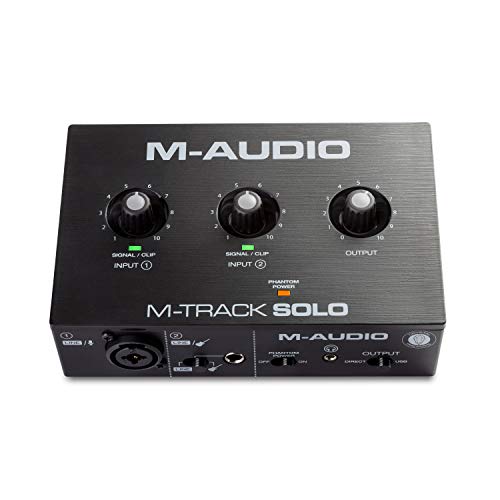
Crafted for aspiring musicians and content creators, the M-AUDIO M-Track Solo USB Audio Interface stands out with its user-friendly design and essential features. This interface supports both Mac and PC, delivering 48 kHz audio resolution for high-quality recordings. You’ll appreciate the combo XLR/Line input with phantom power and the Line/Instrument input for versatile recording options. The 1/8” headphone output and stereo RCA outputs provide flexible monitoring, while the USB/Direct switch guarantees zero-latency feedback. With a transparent Crystal Preamp, your audio captures remain clear, and included MPC Beats Software enhances your music production experience. Elevate your sound today!
Best For: Aspiring musicians and content creators looking for an affordable and user-friendly audio interface for recording and streaming.
Pros:
- High-quality 48 kHz audio resolution ensures clear and professional sound recordings.
- Versatile input options with combo XLR/Line input and Line/Instrument input for various recording needs.
- Zero-latency monitoring feature allows real-time audio feedback for seamless recording sessions.
Cons:
- Limited input channels may restrict simultaneous recording of multiple sources.
- Basic included software might not satisfy advanced users looking for extensive production tools.
- No MIDI input/output could be a drawback for users needing to connect MIDI devices.
Focusrite Scarlett 2i2 4th Gen USB Audio Interface

Looking for a versatile audio interface that meets the demands of recording, streaming, and podcasting? The Focusrite Scarlett 2i2 4th Gen delivers high-fidelity, studio-quality recordings with a 120dB dynamic range. Its Auto Gain feature optimizes levels for your mic or guitar, while Clip Safe prevents distortion. Plus, the Air mode enhances your vocals and instruments brilliantly. You’ll also get essential software like Pro Tools Intro+ and Auto-Tune Access, ensuring you have everything you need. Weighing just 1.73 pounds and compatible with multiple devices, it’s perfect for any setup. With a 4.6-star rating, it’s a top choice among users.
Best For: Musicians, podcasters, and streamers seeking high-quality audio recording in a compact and versatile interface.
Pros:
- Studio-grade converters offering a 120dB dynamic range for exceptional audio quality.
- User-friendly features like Auto Gain and Clip Safe to prevent distortion and optimize levels.
- Includes a comprehensive software bundle, including Pro Tools Intro+ and Auto-Tune Access, enhancing creative possibilities.
Cons:
- Limited to USB-C connectivity, which may require adapters for older devices.
- Might be considered pricey for beginners or casual users not needing advanced features.
- Some users may find the software learning curve steep if new to audio production.
M-AUDIO M-Track Duo USB Audio Interface for Recording and Streaming

The M-AUDIO M-Track Duo USB Audio Interface stands out as an excellent choice for musicians and podcasters seeking versatility in their recordings. With dual XLR, line, and DI inputs, you can effortlessly record vocals, instruments, or line signals. It delivers 48 kHz audio resolution with transparent Crystal Preamps, ensuring your sound quality is exceptional. Plus, the combo inputs come with phantom power, perfect for condenser mics. You’ll appreciate the 1/4” headphone output and stereo outputs for flexible monitoring. Don’t forget the included MPC Beats Software, which enhances your production experience! Elevate your sound today!
Best For: Musicians, podcasters, and content creators seeking a versatile and high-quality USB audio interface for their recording needs.
Pros:
- High audio resolution at 48 kHz ensures exceptional sound quality for recordings.
- Dual combo inputs with phantom power allow for seamless recording of various audio sources, including condenser mics.
- Zero latency monitoring feature provides real-time audio feedback, enhancing the recording experience.
Cons:
- Limited to two inputs, which may not suffice for larger recording setups or group sessions.
- The included software may not meet the advanced needs of professional producers.
- USB-powered, which may limit portability in situations without a computer or USB power source.
MAONO USB Audio Interface for PC (PS22 Lite Black)

For podcasters and voice actors seeking high-quality sound without the complexity, the MAONO USB Audio Interface for PC (PS22 Lite Black) stands out with its impressive 24-bit/192kHz recording capability. With a dynamic range of 106dB, it’s compatible with Mac, Windows, and iPads, making setup a breeze. You’ll love its support for both condenser and dynamic microphones, offering up to 56 dB preamp and 48V phantom power. The compact design includes a light ring to indicate sound status and side headphone monitoring, reducing cable clutter. Plus, it works seamlessly with popular DAWs like Pro Tools and Ableton Live.
Best For: Podcasters and voice actors looking for a high-quality, user-friendly audio interface to enhance their recording experience.
Pros:
- High-resolution 24-bit/192kHz recording for superior sound quality.
- Compact and lightweight design makes it easy to transport and set up.
- Supports a variety of microphones and instruments with 48V phantom power and adjustable impedance.
Cons:
- Effects like noise reduction and reverb need to be added through external DAW software, as the device does not include built-in effects.
- Limited to compatibility with specific DAWs, which may not suit all users’ preferences.
- No dedicated soundpad for adding sound effects during recording.
MAONO Gaming Audio Mixer (MaonoCaster G1 NEO)

Gamers and streamers will find the MAONO Gaming Audio Mixer (MaonoCaster G1 NEO) an excellent choice, thanks to its impressive pro-preamp and built-in noise reduction features. With 48V phantom power, it elevates XLR microphone quality for crystal-clear communication. The intuitive interface allows for distraction-free operation, while voice change options and custom sound pads keep your audience engaged. Plus, the RGB lighting adds a stylish touch to your setup. You’ll appreciate the Bluetooth connectivity for added versatility. Compatible with various devices and streaming software, this mixer is perfect for live streaming, podcasting, and content creation. Elevate your streams today!
Best For: Gamers and streamers looking for a high-quality audio mixer to enhance their live streaming, podcasting, and content creation experience.
Pros:
- Equipped with 48V phantom power for superior XLR microphone audio quality.
- Features voice change options and custom sound pads to engage viewers.
- Bluetooth connectivity and compatibility with various devices and streaming software.
Cons:
- Not compatible with USB microphones or Xbox.
- Limited gain range may not suit all audio preferences.
- RGB lighting may not appeal to all users.
Mackie Onyx Artist 1X2 USB Audio Interface

With its boutique-quality Onyx mic preamp, the Mackie Onyx Artist 1X2 USB Audio Interface stands out as an exceptional choice for musicians and podcasters seeking high-resolution recording. You’ll enjoy high-resolution 24-Bit/192kHz audio with zero-latency direct monitoring, guaranteeing your sound remains crystal clear. The versatile ¼” TRS input with Hi-Z switch accommodates guitars and basses effortlessly. Plus, with 48v Phantom Power, you can use studio condenser mics without hassle. Its USB 2.0 connectivity makes for fast transfer speeds, while the durable, bus-powered design guarantees easy portability. The included Musician Collection software adds even more value to your recording setup.
Best For: Musicians and podcasters looking for high-resolution recording with a portable and durable audio interface.
Pros:
- Boutique-quality Onyx mic preamp provides exceptional fidelity and dynamic range.
- Zero-latency direct monitoring ensures crystal-clear sound during recording.
- Bus-powered design allows for easy portability without the need for an external power adapter.
Cons:
- Limited to 2 inputs and 2 outputs, which may not suffice for larger setups.
- USB 2.0 connectivity may not offer the same speed as newer USB standards.
- The included software bundle may not be as extensive as other competitors.
FIFINE Gaming Audio Mixer with XLR Microphone Interface

The FIFINE Gaming Audio Mixer (Model: SC3) stands out as a top choice for streamers and podcasters seeking an all-in-one solution for high-quality audio management. With its XLR microphone interface and built-in 48V phantom power, you’ll experience enhanced audio quality during recordings. The mixer features one XLR input and four independent channels, allowing you to control microphone, line in, headphone, and line out volumes effortlessly. Plus, the customizable sound effects and voice-changing modes add creativity to your broadcasts. Its vibrant RGB lighting not only looks great but also fits any streaming setup, making it an excellent choice for any content creator.
Best For: Streamers, podcasters, and content creators looking for high-quality audio management with customizable features.
Pros:
- Easy-to-use design with intuitive volume sliders and mute buttons for seamless audio control.
- Customizable sound effects and voice-changing modes enhance engagement and creativity during broadcasts.
- Vibrant RGB lighting adds an appealing visual element that can be adjusted to fit various streaming themes.
Cons:
- Not compatible with USB microphones, limiting options for some users.
- Requires shielded XLR cables for optimal audio quality, which may need to be purchased separately.
- The compact size may not suit users looking for more extensive control features or additional inputs.
BOMGE Mini USB Audio Interface for Recording and Streaming

For musicians and content creators seeking a reliable, high-quality audio interface, the BOMGE Mini USB Audio Interface stands out with its impressive 48 kHz audio resolution. This compact, 2-channel interface is perfect for recording, streaming, and podcasting, catering to guitarists, vocalists, and producers alike. With two combo XLR/MIC/LINE inputs and 48V phantom power, you’ll connect all your gear effortlessly. The zero-latency monitoring via the USB/Direct switch guarantees real-time audio feedback. Plus, its plug-and-play functionality means you’ll be ready to record in no time on both Mac and Windows systems. Enjoy music production anywhere with its ultra-portable design.
Best For: Musicians, podcasters, and content creators looking for a compact and high-quality audio interface for recording and streaming.
Pros:
- High-quality 48 kHz audio resolution for professional sound.
- Plug-and-play functionality for easy setup on Mac and Windows systems.
- Ultra-portable design allows for convenient use in various locations.
Cons:
- Limited to 2 channels, which may not be sufficient for larger recording setups.
- No built-in effects or processing features.
- May require additional cables for specific connections not included in the package.
Factors to Consider When Choosing Audio Interfaces
When choosing an audio interface, you should consider several key factors. Audio quality standards, input/output options, and connectivity types play an essential role in your decision. Additionally, don’t overlook phantom power availability and software compatibility to guarantee a seamless setup.
Audio Quality Standards
Choosing the right audio interface hinges on understanding key audio quality standards, which can dramatically influence your recordings. Look for interfaces that support 24-bit depth at 192 kHz; this guarantees a dynamic range suitable for professional work. A minimum dynamic range of 100 dB is vital to capture both soft and loud sounds without distortion. High-performance mic preamps enhance clarity, allowing you to capture every nuance of vocals and instruments. If you’re using condenser mics, make sure the interface provides 48V phantom power for peak performance. Additionally, prioritize zero-latency monitoring; this feature allows you to hear yourself in real-time during recording, which is essential for maintaining your performance quality.
Input/Output Options
Selecting the right audio interface involves understanding the input and output options available to you. First, consider how many input channels you need; this affects how many instruments or microphones you can record simultaneously. Common configurations are 2 in/2 out, but advanced models offer even more. Look for combo XLR/line inputs to accommodate both mics and instruments, as well as dedicated inputs for guitars or bass. Evaluate output options like balanced outputs for studio monitors and headphone outputs for monitoring. Don’t overlook features like phantom power for condenser mics and USB/direct monitoring to minimize latency. Finally, verify compatibility with your setup, as different interfaces use various connections like USB-C or USB 2.0, affecting ease of use.
Connectivity Types
Understanding connectivity types is essential for maximizing your audio interface’s potential. Most audio interfaces connect to your computer via USB, with options like USB-A, USB-C, and USB 2.0, each offering different speeds and compatibility levels. If you want versatility, consider interfaces that provide dual connectivity, such as USB and Bluetooth, which allow you to connect with smartphones or tablets easily. Keep in mind that the connection type can impact latency; USB 2.0 generally offers lower latency compared to older standards. Many modern interfaces also support plug-and-play functionality, making setup a breeze. Finally, check if the interface has balanced outputs to reduce interference and guarantee cleaner audio signals when connecting to monitors or speakers.
Phantom Power Availability
When you’re setting up your audio interface, considering phantom power availability is essential, especially if you plan to use condenser microphones. These microphones require an external voltage supply, typically 48V, to function effectively during recording sessions. By ensuring your audio interface supports phantom power, you’ll maximize the performance and sound quality of your high-end mics. Many interfaces come with phantom power switches, allowing you to easily activate or deactivate this feature based on your microphone needs. This is particularly important in studio settings where high-quality vocal and instrument recordings are a priority. So, before making a purchase, double-check whether the audio interface you’re considering has phantom power capabilities to meet your recording demands.
Software Compatibility
How well does your audio interface work with your computer and software? It’s essential to verify compatibility with your operating system—be it Mac, Windows, or iOS—so you can enjoy seamless integration. Check if the interface supports popular digital audio workstations (DAWs) like Pro Tools, Ableton Live, or Cubase, as this will enhance your recording and production capabilities. Additionally, look for interfaces that include fundamental software or plugins, which can considerably improve your audio production experience. Don’t forget to confirm support for low-latency drivers; they’re crucial for real-time monitoring and recording without delays. Finally, consider features like virtual channels or loopbacks to enhance your streaming capabilities and flexibility in various software environments.
Portability and Design
Portability and design are essential factors to take into account when choosing an audio interface, especially for musicians and content creators on the go. A compact and lightweight model, typically weighing around 1 to 2 pounds, makes travel easier without compromising functionality. Look for interfaces that utilize USB connectivity for bus-powered operation, so you won’t need external power sources while on the move. A streamlined profile helps reduce cable clutter, allowing for quick setups in various environments. Finally, opt for interfaces with a rugged build quality—often described as “Built-Like-A-Tank”—to guarantee they withstand frequent travel and diverse recording situations. With these considerations, you’ll find an audio interface that perfectly fits your mobile lifestyle.
Monitoring Features
Monitoring features play an essential role in ensuring you capture high-quality recordings. Look for audio interfaces that include headphone outputs and direct monitoring options, which let you listen to your recordings in real-time without latency. Zero-latency monitoring is vital, allowing you to hear audio input directly without any disruptive delay. Many interfaces offer multiple output options, such as stereo RCA outputs or 1/4” outputs, giving you flexibility for connecting to studio monitors or headphones. Some models come with dedicated monitoring controls, enabling you to adjust the balance between direct input and playback. Additionally, visual indicators like LED metering or dynamic light rings help you monitor audio levels, ensuring peak recording quality throughout your sessions.
Price and Budget
When choosing an audio interface, price and budget are significant factors that can greatly affect your decision. Interfaces can range from around $50 to over $1,000, depending on features and audio quality. If you’re on a tight budget, entry-level models offer basic functionalities, while pricier options provide superior preamps and higher sampling rates. Remember, investing in a higher-end interface can pay off in durability and often comes with longer warranties. Many budget interfaces also include bundled software, adding extra value to your purchase. Don’t forget to factor in additional expenses, like cables, microphones, and software, when setting your budget. Make sure you choose an interface that fits both your needs and your wallet.